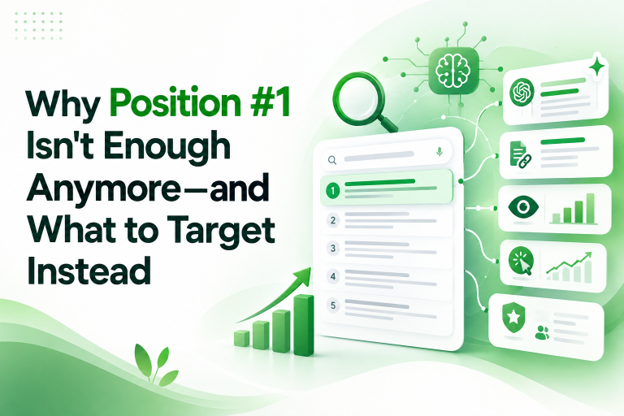
For years, one of the easiest ways to judge SEO was to ask a simple question: where do we rank on Google? Move an important keyword from page two to position three, then eventually to position one, and the improvement was visible and easy to understand. Higher rankings generally meant more clicks, more traffic, and ideally more leads or sales. That relationship still matters in 2026, but it is no longer nearly as straightforward.
Google Search has changed as AI Overviews, AI Mode, featured answers, local results, shopping features, and video occupy more of the results page. A business can now rank first organically for an important keyword and receive fewer clicks than the same ranking would have generated a few years ago, while another company appears inside an AI generated answer and influences a customer without holding the top organic position. This does not mean ranking first has lost its value. It means ranking position alone no longer tells you whether your business is winning in search, and modern measurement needs to account for traditional rankings, AI visibility, brand recognition, qualified traffic, and ultimately whether search contributes to meaningful business results.
AI Overviews Are Changing the Value of a Number One Ranking
The impact becomes clearer when you look at actual search behavior. SISTRIX analyzed more than 100 million keywords in Germany and found that the first organic position earned an average click through rate above 27 percent on traditional results. When an AI Overview appeared, position one click through rate fell to roughly 11 percent, a decline of almost 60 percent. Those figures do not mean every number one ranking suddenly generates 60 percent fewer clicks, since behavior varies by query, industry, device, intent, and the features on the page. What they demonstrate is that the same ranking position can now carry dramatically different value depending on what surrounds it.
Zero click behavior reinforces the shift. An often repeated figure puts U.S. zero click searches at 58.5 percent, but that comes from 2024 research and is now out of date. More recent 2026 research from SparkToro and Similarweb found that roughly 68 percent of U.S. Google searches during the first four months of 2026 ended without a click. Google offers a different emphasis, saying overall organic click volume has stayed relatively stable, that the clicks it sends are becoming higher quality, and that AI experiences encourage people to run more and increasingly complex searches. Both perspectives can be true at once: searchers may click less on any single query while running more searches overall and arriving with greater intent. Either way, raw ranking and traffic numbers mean less in isolation. This is the same dynamic reshaping paid search, where click-through rates are being squeezed by AI Overviews on informational queries.
SEO Success Should Be Measured by Visibility, Not Just Position
Imagine two law firms competing in the same market. Firm A ranks number one for several high-volume keywords but rarely appears in AI answers, has limited branded search demand, and receives informational traffic that produces few consultations. Firm B ranks between positions two and five, appears regularly in relevant AI responses, has stronger brand recognition, and generates fewer but far more qualified visits. A traditional ranking report would crown Firm A; a business owner looking at actual marketing impact could easily reach the opposite conclusion.
This is why modern reporting needs to move beyond a scoreboard of keyword positions. Rankings still belong in the conversation, because they show how Google evaluates your relevance and authority, but they need to be read alongside what happens before the click, after the click, and increasingly when no click occurs at all. Businesses become attached to highly visible metrics because they are easy to understand, yet ranking number one and ten thousand organic visitors tell you nothing about whether those visitors were prospective customers or whether search contributed to revenue. The goal of SEO was never really rankings; rankings were a means of reaching the right people, and as the search experience changes, businesses need better ways to measure whether that objective is being met.
AI Visibility Is Becoming a New Layer of Search Performance
One of the most important additions to modern measurement is AI visibility, sometimes called AI share of voice. Instead of asking only where your website ranks, businesses should increasingly ask whether their company, services, expertise, or content appear when people pose questions to AI systems, including Google AI Overviews and AI Mode as well as ChatGPT, Gemini, and Perplexity. This matters because AI generated answers can shape a customer consideration process before that person ever visits a website, and being included creates brand exposure even when it produces no immediate website session.
Google direction makes this hard to ignore. At Google I/O 2026, the company reported that AI Mode had passed one billion monthly users and that queries were more than doubling every quarter, and it keeps adding links, citations, and preferred sources across its AI experiences. AI visibility should complement traditional reporting rather than replace it, though. A business that appears often in AI answers but has weak rankings, poor conversion, or little authority in its core market still has real problems to solve. The objective is visibility across the customer’s entire search journey, not dominance of one isolated metric.
Attribution Is Getting Harder, So Watch Trends Across Sources
AI search creates an attribution problem businesses will increasingly meet. Suppose a customer asks an AI platform for recommendations, sees your company mentioned, and rather than clicking a citation, remembers your name and later searches Google directly. Analytics may record that as organic search while Search Console records a branded query, and neither reveals that an AI recommendation influenced the person. This is why branded search demand deserves more attention. A rise in searches for your company name, people, or distinctive services can indicate awareness growing beyond nonbranded search. AI exposure may contribute, but so can PR, social media, referrals, and word of mouth, so branded search growth is a useful signal rather than proof that any one channel caused it.
The same caution applies to identifiable AI referral traffic. Visitors arriving from ChatGPT, Perplexity, and Gemini offer valuable insight into which pages AI users discover and how they behave, and you can compare their conversion and outcomes against traditional search. The limit is attribution: not every AI influenced visit carries a recognizable referral source, since a user may discover you through an AI answer and later type your URL, run a branded search, or return days later from another device. AI referral traffic is the measurable portion of AI influenced traffic, not the whole picture, which is why the broader lesson for 2026 is to depend less on any single dashboard, since trends across multiple sources tell a more accurate story.
Traffic Matters Less Without Engagement and Conversion Context
The same shift applies to website traffic. A business that loses 15 percent of organic traffic may assume its SEO has declined, but what if most of the lost visits came from basic informational queries that AI Overviews now answer directly, while calls, form submissions, purchases, and qualified leads stayed stable? That business may have a healthier search channel than the traffic graph suggests, which is exactly why a mid-year performance review should look past the headline number. Google has stated that clicks from AI experiences can be higher quality, with users more likely to stay on the sites they visit, which makes post click behavior increasingly important.
Metrics such as engaged sessions, conversion rate, phone calls, form submissions, revenue, and qualified lead volume reveal what traffic actually accomplishes. Average engagement time can add context, but it is worth being precise about one thing that is commonly overstated: time on page, scroll depth, and return visits are not confirmed ranking factors in Google algorithm. Google has not established that those GA4 metrics directly determine rankings; they are better understood as business and user experience indicators. The more useful question is not whether organic traffic increased, but whether the right organic traffic increased, and what those visitors did.
A Better SEO Scorecard Connects Visibility to Business Results
Modern measurement does not mean abandoning keyword rankings. It means putting them in context. A useful 2026 scorecard evaluates traditional organic visibility alongside AI visibility, branded search demand, qualified organic traffic, website conversions, and measurable AI referrals, weighted to the business. This is where one size fits all reporting fails. A personal injury firm seeking qualified consultations should not be judged by the same metrics as an ecommerce retailer tracking organic revenue, and a local contractor should care about geographic visibility and phone calls while a national B2B company values qualified form submissions. The strongest framework begins with the business objective and works backward, treating rankings, traffic, AI citations, and engagement as diagnostic indicators of whether search is reaching the right audience and generating real opportunities for growth.
Frequently Asked Questions
How often should businesses review AI visibility?
Often enough to identify trends rather than isolated mentions. Monthly reporting suits many businesses, though highly competitive or fast-changing industries may benefit from more frequent monitoring. Because AI responses vary between prompts and over time, track a consistent group of commercially relevant questions rather than relying on a handful of one-off manual searches, so you are measuring a pattern instead of a snapshot.
Should informational keywords still be part of an SEO strategy?
Yes, when they serve a purpose. Informational content can establish expertise, introduce potential customers to your brand earlier in their research, support AI citations, and strengthen topical authority. The key is recognizing that informational traffic may not convert immediately, so its success should not be judged by direct leads alone but by the role it plays across the wider journey.
Can a business measure whether AI citations generate customers?
Only partially. Direct referrals from some AI platforms can be tracked in analytics, but many AI influenced journeys surface later as branded search, direct traffic, or another channel. Rather than expecting perfect attribution, combine AI visibility monitoring, referral data, branded search trends, and conversion reporting, and look for the moments when several of those signals move together.
Should SEO agencies still provide keyword ranking reports?
Yes. Rankings remain useful diagnostic information and should keep being reported. The problem arises only when rankings become the primary definition of success. A modern report should connect ranking movement with AI visibility, traffic quality, conversions, and local performance where relevant, so position is one input among several rather than the verdict.
Does lower organic traffic automatically mean SEO is performing worse?
No. Declining traffic can indicate a problem, but it can also reflect changing search behavior, AI generated answers, seasonality, or fewer low value informational clicks. Before concluding that performance has deteriorated, determine which pages and queries lost traffic and whether qualified leads, sales, and conversions actually changed, because the headline number alone can be misleading.
The Goal of SEO Has Not Changed, but the Scoreboard Has
Ranking number one is still valuable. Organic rankings continue to help businesses earn visibility, establish authority, and reach customers at important points in the buying process. What has changed is the assumption that a number one ranking automatically produces the same traffic or business impact it once did, because AI Overviews, AI Mode, zero click searches, and changing behavior are creating a broader environment in which visibility can occur without a website click. The companies best prepared for this transition will not stop caring about rankings. They will simply stop letting rankings tell the entire story, which is a calmer and more accurate way to judge whether search is doing its job.
At LAD Solutions, we help businesses evaluate search performance across traditional SEO, local SEO, AI Search Optimization, website engagement, conversion tracking, and lead generation, so marketing decisions rest on meaningful data rather than a single metric. If you are unsure whether your current reporting reflects how customers actually discover businesses in 2026, call 844.523.2556 or contact LAD Solutions at www.LADSolutions.com to schedule a consultation and identify where your strongest opportunities for sustainable visibility and qualified growth may be.