
Most businesses still think about search as something a customer starts. Someone needs a service, opens Google, asks a question, reviews the results, and decides where to go next. For more than two decades, SEO has been built around appearing at that moment of demand. Google new information agents begin to change that model.
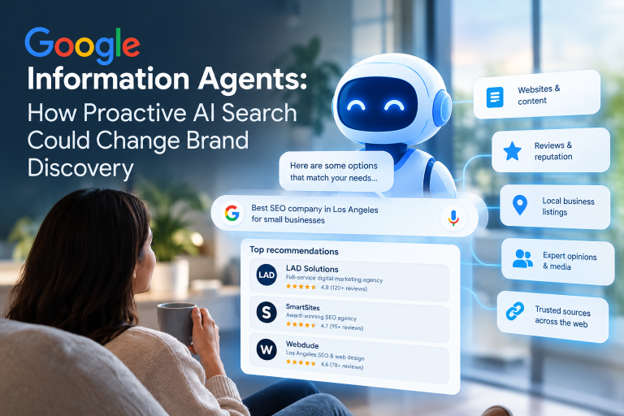
Google introduced information agents at Google I/O 2026 on May 19, and the feature is no longer just an announcement. Since June 12, 2026, information agents have been live for Google AI Ultra subscribers across all AI Mode languages and markets, with AI Pro named as next in line and broader availability expected to follow. These are personalized agents that work in the background around the clock to monitor topics a user cares about. Instead of requiring someone to run the same search repeatedly, an agent keeps watching the web and notifies the person when something worth knowing appears, examining sources such as blogs, news sites, and social posts along with live finance, shopping, and sports data, then delivering synthesized updates with links to explore further.
For business owners, the significance goes beyond another AI feature. Search is beginning to move from a system that responds when people ask questions toward one that keeps researching after the query is over. That raises a new marketing question: if a customer asks Google to keep monitoring an industry, product category, or local market, will your company keep providing information worth surfacing?
Information Agents Turn Search Into an Ongoing Research Process
A useful way to understand the concept is to compare it with Google Alerts, but with far more intelligence behind it, a framing Google itself has used. A traditional alert watches for keywords or newly indexed content. An information agent can reason across information, interpret detailed criteria, recognize meaningful changes, synthesize what it finds, and deliver an update rather than a list of links. Setup is conversational: inside AI Mode a user simply says something like keep me updated on a topic, with no keywords to configure, and can run several agents at once.
That distinction matters because people no longer need to remember to search again. Consider a business owner researching digital marketing agencies in Los Angeles. Today they might run several searches over a few weeks before deciding. In an agent-based environment, they could ask Google to monitor agencies that meet particular requirements and keep them updated when something meaningful changes. A company might therefore reach that buyer more than once: an educational article could create the initial introduction, a newly published case study could reinforce expertise later, and a genuine business or industry development could surface the brand again. Search becomes less like a single visit and more like an ongoing research relationship.
Brand Discovery Can Continue When Customers Are Not Actively Searching
Traditional SEO focuses on capturing intent at a specific moment. Someone searches for an SEO company in Los Angeles or a commercial HVAC contractor, and businesses compete for that results page. Information agents introduce persistent intent: a person expresses interest once and lets Search keep monitoring in the background, so Google retains the context of what the user cares about and looks for developments on their behalf. This matters most in industries with longer buying cycles, such as professional services, commercial real estate, B2B software, healthcare, and home improvement, where the decision often takes weeks or months of research rather than a single search.
There is a detail here that deserves more attention than it usually gets, because it inverts the story of the last two years. Unlike zero click AI Overviews, which answer inside the results page, information agents push updates that link back to the web. For a business, that means an earned citation can become a proactive, around the clock referral rather than a dead end. After a long stretch of anxiety about clicks disappearing into AI answers, this is one of the first AI surfaces designed to send people to sources. The practical implication is that your digital presence needs useful information for different stages of the journey: service pages that explain what you do, educational content that establishes expertise, case studies that demonstrate experience, reviews that reinforce trust, and timely commentary that shows you remain engaged with your field. An agent researching a topic over time could encounter all of those signals.
Freshness Matters, but Publishing More Is Not Automatically Better
Information agents clearly make ongoing relevance more important, but businesses should not read that as a mandate to publish something every week just to look active. Google has not stated that agents reward a particular publishing frequency or that frequently updated sites automatically receive preference. The better principle is meaningful freshness. Evergreen content still matters, because many customer questions do not change quickly; a strong guide on how to choose an SEO company can stay useful for years if it is reviewed and updated when needed, and a weaker monthly replacement would not improve it. Other topics genuinely need current information, including algorithm updates, regulatory changes, product launches, and new case results.
This is where businesses should separate content cadence from content contribution. At LAD Solutions, we would rather see a company publish two genuinely useful pieces in a month than eight that repeat information already available across hundreds of websites. AI systems exist to synthesize information, so content that adds nothing new gives them very little reason to rely on that source.
Original Information Becomes Even More Valuable in Agent Based Search
Information agents reinforce the value of becoming a source rather than summarizing other sources. Imagine an agent monitoring changes in an industry. If twenty websites publish nearly identical summaries of the same announcement, the agent does not need all twenty to understand what happened; the sites contributing original information have something fundamentally different to offer. Originality does not always require expensive research. A law firm can explain how a regulatory development affects its clients, a contractor can document lessons from a difficult installation, an ecommerce company can share insights from customer buying patterns, and a marketing agency can analyze changes it observes across campaigns instead of simply repeating Google announcement.
This type of content demonstrates experience rather than just knowledge, and that distinction is becoming more important across both traditional SEO and AI Search Optimization. AI systems can summarize generic information extremely efficiently. Businesses create greater value when they contribute expertise, evidence, analysis, or data an AI system cannot obtain by summarizing the first ten articles on the same subject. That is also good marketing on its own terms, because original insight gives customers a reason to remember the brand behind the information.
Consistent Business Information Matters More When AI Synthesizes Sources
Information agents do not operate only within your website. Google explicitly says they can reason across information from different areas of the web, which makes factual consistency a real consideration. Imagine your website lists one office location, your Google Business Profile shows another, an old directory lists a previous phone number, and third-party profiles describe services you no longer offer. A human researcher might recognize which details are outdated. An AI system synthesizing several sources has to reconcile those contradictions, and inconsistency makes you harder to represent accurately.
Businesses should therefore treat reputation management, local SEO, structured data, and entity consistency as interconnected parts of AI visibility. Your company name, locations, services, leadership, contact details, and credentials should be accurate across authoritative platforms, and your website should clearly explain the organization behind the content. Structured data can reinforce those relationships by identifying organizations, people, services, and locations in machine readable form. It does not guarantee inclusion in an agent response, but reducing ambiguity helps search engines interpret your site more accurately.
Prepare for Proactive Search Without Chasing an Unproven Algorithm
Information agents are worth preparing for, but new technology creates a predictable problem: businesses begin optimizing for assumptions before anyone knows how the system actually works. There is currently no published information agent optimization formula, and you should be cautious of anyone promising guaranteed placement inside agent updates or claiming that a particular content frequency, schema setup, or technical file automatically produces visibility. The strongest strategy is much less dramatic. Create content customers genuinely want to know about, keep important evergreen resources accurate, publish updates when you have something meaningful to contribute, strengthen your brand across reputable third-party sources, and monitor how customers discover you across traditional and AI search. These actions already support SEO, AI visibility, brand authority, and trust, so if information agents become central to how people discover businesses, the same foundation should leave you well prepared. The objective is not to manipulate an agent into mentioning you; it is to become a source the agent has legitimate reasons to find useful.
Frequently Asked Questions
Are Google information agents available now?
Yes, in a limited form. Google announced information agents at I/O 2026 on May 19, and launched them on June 12, 2026 for Google AI Ultra subscribers across all AI Mode languages and markets. Google named AI Pro subscribers as next in line, with broader availability expected later, so most users cannot access the feature yet. You create an agent conversationally inside AI Mode by asking Google to keep you updated on a topic, and you can manage active agents there.
Will information agents replace Google Alerts?
Google has not said Google Alerts is being replaced. Information agents are a considerably more advanced concept, because they can reason across information and synthesize updates based on detailed criteria, while Alerts traditionally monitor the web for matching content. In practice, agents behave like a much more capable successor to the alert idea rather than a direct swap, and Google itself has drawn the comparison.
Can businesses optimize specifically for information agents?
Google has not published a dedicated ranking system or optimization checklist for information agents. Businesses should focus on established principles such as helpful content, accurate business information, technical SEO, brand authority, and meaningful new information rather than trying to optimize for unconfirmed signals. Be skeptical of any service promising guaranteed placement inside agent updates, since no such method has been confirmed to exist.
Does every business need to publish content more frequently?
No. Publishing frequency should depend on whether a business has something useful to contribute. Industries that change often may benefit from more timely content, while businesses with relatively stable topics may gain more from maintaining authoritative evergreen resources and publishing new material only when it adds genuine insight. Volume for its own sake gives AI systems little reason to prefer your source.
How can businesses measure visibility within information agents?
Measurement is still developing because the feature is new and access is limited. Businesses should continue monitoring traditional SEO performance while expanding AI visibility tracking to include brand mentions, citations, referral traffic, branded search trends, and the kinds of questions where their company appears across emerging AI search experiences. Because agents link back to sources, referral traffic from AI surfaces is worth watching closely as availability widens.
Search Is Becoming Proactive, but Good Marketing Principles Still Apply
Google information agents represent a real change in how search can work. Instead of relying entirely on users returning to Google and repeating searches, Search can increasingly keep monitoring topics, synthesize new information, and bring meaningful developments back to the person, with links to the sources behind them. For businesses, that creates a new opportunity to stay visible throughout a longer research process, and it raises the value of accurate information, meaningful updates, original expertise, and a recognizable brand presence across the web.
The businesses best prepared for this environment will not be the ones publishing most often. They will be the ones consistently giving customers, search engines, and AI systems useful reasons to pay attention. At LAD Solutions, we help businesses prepare for the evolving search landscape through SEO, AI Search Optimization, local SEO, content strategy, technical SEO, and brand visibility analysis. If you want to understand whether your current digital presence is ready for Google information agents and other emerging AI search experiences, call 844.523.2556 or contact LAD Solutions at www.LADSolutions.com to schedule a consultation and identify the opportunities that matter most for your business.