
A business can spend thousands on a professional website, publish strong content every month, invest in SEO, and still watch competitors turn up in Google AI Overviews and AI generated recommendations while it rarely does. Search around for the reason and you will quickly be told the culprit is missing schema markup, and that adding structured data is how you get into AI answers. That advice is half right, and the wrong half is expensive.
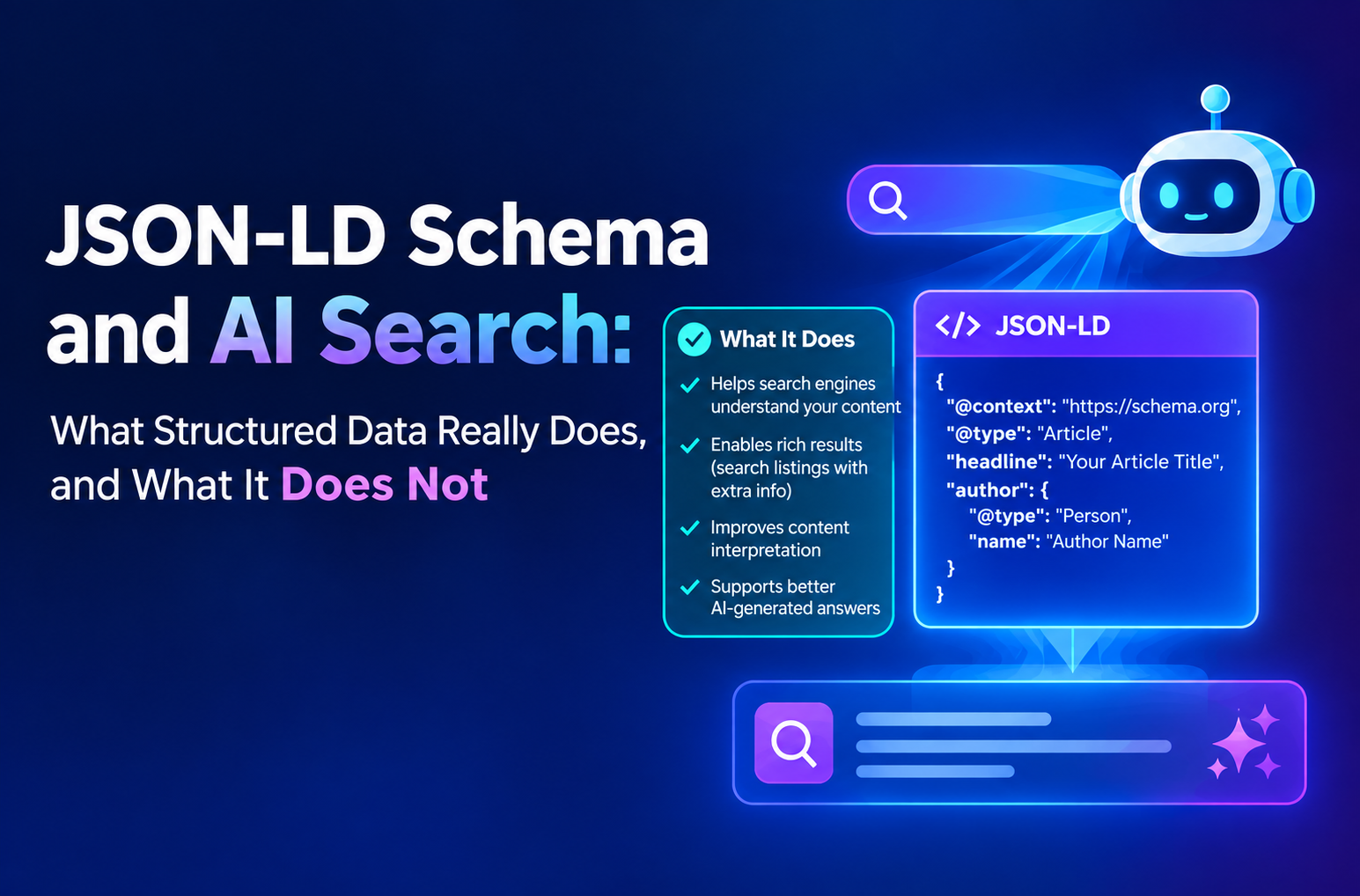
JSON-LD schema is genuinely worth implementing, and most business websites do underuse it. But it does not work the way it is usually sold, and Google has been unusually direct about that. Getting this right matters, because businesses are being sold schema as a shortcut to AI visibility that it is not, while the real value it offers goes underused. Here is the honest version of what structured data does, what it does not, and where your effort actually pays off.
Schema Helps Machines Trust Their Understanding of Your Site
Start with what schema is genuinely good at. A person visiting your website combines dozens of cues, your logo, address, services, reviews, and navigation, and understands within seconds that you are a law firm, a dental practice, or a contractor. Search engines have become remarkably good at inferring the same things from text, but inference still leaves room for doubt. JSON-LD schema removes that doubt by stating the facts explicitly in a vocabulary machines recognize: this page belongs to this business, which serves this area, and this section is a service, an article, or a set of questions and answers.
The useful way to think about it is that structured data is less about helping Google find information and more about helping Google trust its understanding of that information. That is a real benefit, and it becomes more relevant as answers are assembled by systems that need to be confident before they cite anything. But confidence is not the same as a guarantee, and this is exactly where the marketing tends to overreach.
What Google Actually Says About Schema and AI
Because this is where most advice goes wrong, it is worth stating plainly. In its 2026 guidance, Google says that structured data is not required for its Search generative features, including AI Overviews and AI Mode, and that there is no special Schema.org markup that makes you appear in them. Google Search Relations has also stated repeatedly that structured data is not a direct ranking factor. And schema is not a citation switch; pages with no markup at all get cited in AI answers constantly. If an agency tells you that adding schema is how you get into AI Overviews, they are describing something Google has explicitly said is not true.
There is also a platform distinction the usual advice skips. Most third-party AI systems, including ChatGPT and Perplexity, largely strip JSON-LD during retrieval and work from the visible content of your page. So for those platforms, schema helps only indirectly, by strengthening the organic rankings and entity clarity that put your content in the running at all. You may see confident third-party studies claiming large citation lifts from schema. Treat those as correlation from independent panels rather than proven cause; Google has confirmed no such direct effect, and the sites in those studies tend to do many things well at once.
Where Schema Genuinely Earns Its Place
None of that makes schema optional, because its real value sits in three places that have nothing to do with a citation shortcut. The first is rich results in traditional search, where eligible markup can still earn enhanced listings, though note that Google has narrowed some formats, including removing FAQ rich results for most sites. The second, and most underrated, is entity disambiguation. Organization markup with a sameAs property linking to your verified profiles, and where appropriate to your Wikipedia or Wikidata entry, helps Google understand your business as a distinct entity in its Knowledge Graph, which is foundational to being represented accurately everywhere.
The third is the honest, indirect AI benefit. Independent analysis suggests structured data influences Google AI surfaces materially but indirectly: it feeds the entity understanding and content classification that sit underneath how Google retrieves and assembles answers, so on competitive queries where several passages are equally relevant, clean markup can be part of how Google tells them apart. That is a supporting role, not a lever you pull, and it is worth doing for that reason without pretending it is a switch. The throughline across all three is the same: schema makes an already good website unambiguous, which strengthens everything else you are doing rather than substituting for any of it.
Which Schema Types Deliver the Most Value
A common misconception is that a site needs dozens of schema types. In practice most local and service businesses benefit from a small set implemented correctly. The foundation is Organization or LocalBusiness schema on the homepage, identifying your name, logo, contact details, location, and service area, and acting as an identity card for your company; this is also where certifications, awards, and the sameAs links that aid entity disambiguation belong. Service schema on each primary service page identifies the service, what it includes, the provider, and the areas served, which helps systems connect your offering to the questions people ask.
Article schema on blog posts supplies title, author, publisher, and publication and modification dates, which support authorship and freshness. BreadcrumbList schema, though users rarely notice it, helps machines understand how your pages relate, so your site reads as a connected knowledge source rather than scattered pages. FAQPage schema is worth a note of caution: it no longer earns FAQ rich results for most sites, and Google has not confirmed it directly influences AI citation, so add it only where you have genuine questions and answers, not to chase SERP space that no longer exists. Above all, one rule governs every type: your schema must mirror what is visible on the page. Google enforces content parity strictly, and markup describing things a visitor cannot see can be flagged as spammy structured data, which does real harm.
Implementing Schema Correctly Matters More Than Implementing More
Search engines value accurate, consistent, well maintained structured data far more than sheer volume. Duplicate schema, conflicting business details, or outdated markup create confusion rather than clarity, and the goal is to remove uncertainty, not to bury Google in it. For most WordPress sites, tools such as Yoast SEO generate several important types automatically, including Organization, Article, and Breadcrumb schema, which is a solid starting point. Many businesses stop there, though, and miss that service pages, genuine FAQ sections, and certain organization details often need custom JSON-LD to communicate clearly.
Our approach is to combine that automation with carefully built custom schema that reflects each site actual structure, keeping everything consistent and, crucially, keeping it in parity with the visible page. Schema is also not a one time project. As a site grows, new service pages, articles, locations, and FAQs should be supported by appropriate markup, and it should be validated during regular technical SEO audits. Like the rest of technical SEO, it works best as an ongoing discipline rather than something implemented once and forgotten.
Frequently Asked Questions
Does adding JSON-LD schema improve my Google rankings?
Not directly. Google Search Relations has stated that structured data is not a direct ranking factor, so schema is not a shortcut to higher positions. What it does is help search engines and AI systems interpret your website accurately and make you eligible for rich results where they still exist. Combined with high-quality content, strong user experience, and technical SEO, it strengthens your foundation and supports long term visibility, but it should be understood as clearer communication rather than a ranking lever.
Does schema markup get my business cited in AI answers?
Not on its own. Google has stated that structured data is not required for its AI features and there is no special markup for them, and pages without any schema are cited constantly, so it is not a citation switch. Schema can help indirectly by clarifying your business as an entity and supporting the rankings that put you in consideration, and on Google surfaces it feeds the entity understanding underneath how answers are assembled. Most third-party platforms such as ChatGPT and Perplexity read your visible content rather than your markup, so for them the content itself matters most.
Does every page need its own schema?
In most cases the schema should match the purpose of the page rather than being applied uniformly. A homepage benefits from Organization or LocalBusiness schema, service pages from Service schema, blog posts from Article schema, and genuine FAQ sections from FAQPage schema. Matching the markup to what the page actually is provides far more value than repeating the same schema everywhere, and it keeps your structured data honest and in parity with the visible content.
Can WordPress plugins handle all schema automatically?
Plugins such as Yoast SEO are an excellent starting point and generate several important types automatically, including Organization, Article, and Breadcrumb schema. Many business sites, though, need customization the plugins do not provide by default, particularly Service schema, well-built FAQ markup, and certain organization details. Combining plugin automation with custom JSON-LD usually gives search engines and AI systems the most accurate picture, provided every field mirrors what is visible on the page.
How often should structured data be reviewed?
Whenever you make meaningful changes to the site. New service pages, updated business details, additional locations, revised FAQs, and new content all create opportunities to improve or, if neglected, to break your markup. Because Google enforces parity between schema and visible content, outdated markup can quietly become a liability, so schema validation belongs in your regular technical SEO audits alongside checking that each type still matches what the page actually shows.
Structured Data Is About Clarity, Not a Shortcut to Visibility
As search shifts toward AI generated answers, it is tempting to look for a technical switch that puts you in them, and schema is the one most often sold that way. The honest picture is quieter and more durable. Structured data will not manufacture visibility, get you cited by itself, or lift your rankings on its own, and Google has said as much plainly. What it does is remove doubt, making an already strong website unambiguous to the systems that read it, so your genuine expertise is interpreted accurately rather than guessed at.
That is a foundation worth building well, precisely because it is not a trick. Schema works alongside helpful content, sound technical SEO, entity clarity, and a good user experience, and it strengthens all of them. Businesses that implement it thoughtfully, accurately, and in parity with what visitors actually see are not chasing this month AI feature; they are making themselves easier to understand, which tends to pay off no matter how search evolves.
If you are not sure whether your current schema is helping, doing nothing, or quietly working against you, that is worth checking properly rather than guessing. LAD Solutions reviews your structured data as part of a technical SEO and AI Search Optimization audit, identifies where clearer markup would genuinely help, and makes sure everything stays accurate and in parity with your site. Call 844.523.2556 or visit www.LADSolutions.com to schedule a consultation, and we will tell you honestly where schema fits in your strategy and where your effort is better spent.