

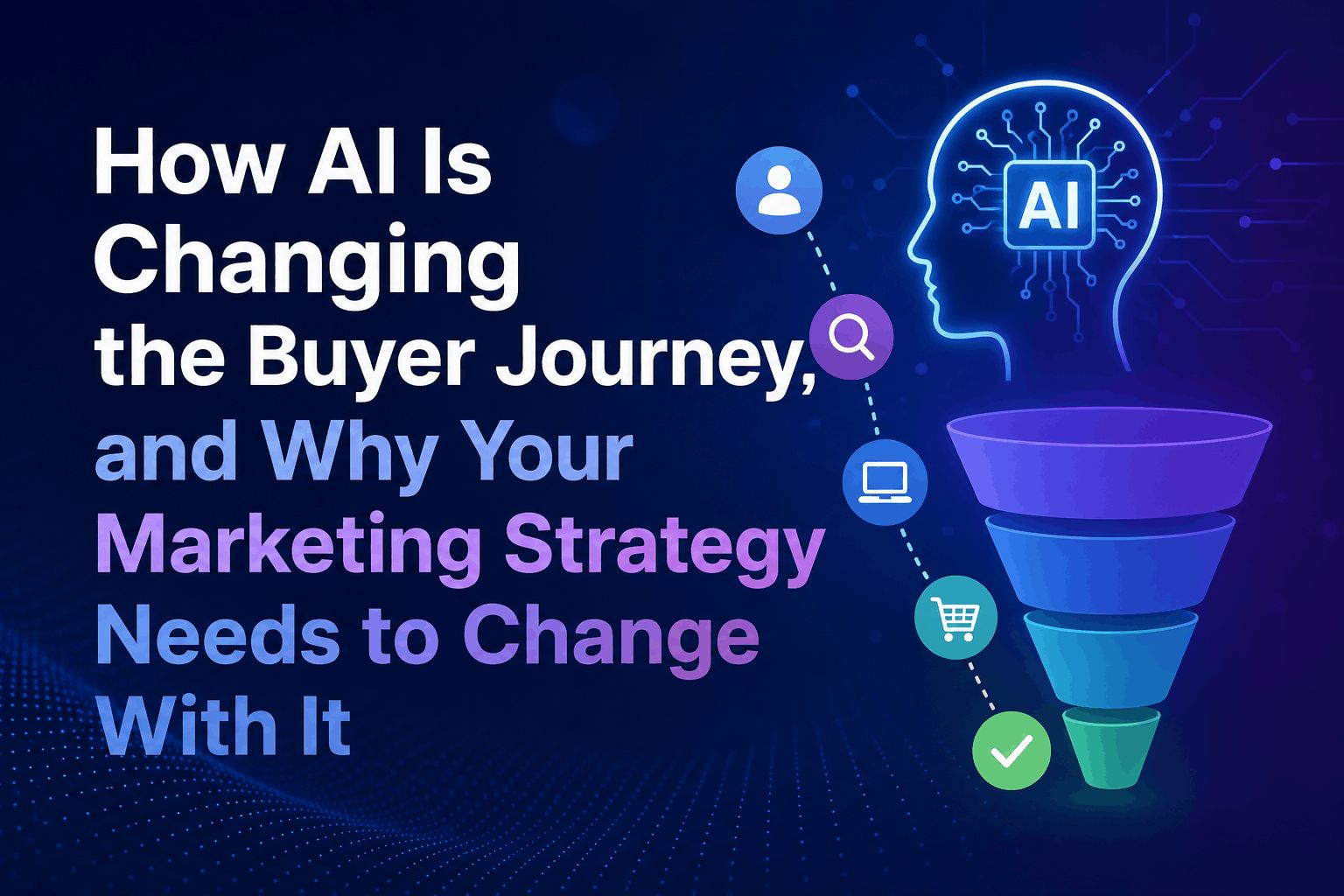
For years, businesses built their marketing around a predictable customer journey. Someone recognized a problem, searched Google, visited several websites, compared providers, and eventually contacted the company they judged the best fit. Every stage created a chance to influence the buyer through SEO, Google Ads, social media, email, and a well-designed website. That process still exists, but it no longer begins where most businesses think it does.
A growing number of buyers now start their research by talking to artificial intelligence rather than browsing websites. They ask ChatGPT, Google AI Mode, Gemini, and Perplexity to compare companies, explain complex topics, recommend providers, and summarize reviews. By the time many of them reach your website, they have already completed much of the research that used to happen during the awareness and consideration stages of the funnel. For business owners, this is one of the most significant shifts since Google became the dominant search engine, because it changes how customers discover businesses, how trust is built, and how decisions are made. Companies that keep marketing as though every customer starts with a Google search risk losing ground to competitors who understand where those decisions now begin.
Your First Impression May No Longer Come From Your Website
Many owners invest heavily in their website because they assume it is where prospects first learn about the company, arriving knowing very little. That assumption is increasingly wrong. Picture someone looking for a digital marketing agency. Five years ago they searched Google, opened several sites, compared services, and slowly narrowed the field. Today they are just as likely to ask an AI platform which SEO agencies specialize in helping law firms, or to compare the best digital marketing agencies for local businesses in Los Angeles.
Instead of ten links to sort through, they receive a composed answer that introduces several companies, explains their strengths, and often suggests which may fit a particular situation. Before your website has a chance to make a first impression, an AI system has already shaped the buyer perception of your business. This is the change worth sitting with: your website is no longer always responsible for creating awareness. Increasingly, its job is to confirm the confidence a buyer has already built during AI assisted research.
AI Is Expanding the Research Phase Instead of Eliminating It
It is tempting to assume AI shortens the buying process because answers come faster. Often the opposite is true. AI lets buyers ask far more questions than they would during a traditional search, continuing one conversation that grows more specific as it goes. One question leads to another, and they explore concerns, weigh options, and understand the decision more fully before contacting anyone.
Google own data confirms the pattern. In its first-year AI Mode usage report, published alongside I/O 2026 in May, Google reported that the average AI Mode search is three times longer than a traditional search, that follow-up queries rose more than 40 percent month over month in the US, and that planning-related queries grew about 80 percent faster than AI Mode queries overall in the previous six months. AI Mode has passed a billion monthly users. People are not running isolated keyword searches; they are having research conversations that evaluate products, services, and providers before a website ever enters the picture.
This has a direct marketing implication. Businesses that publish only promotional content tend to be absent from these conversations, because promotion does not answer the questions buyers actually ask during research. Customers want to understand what separates one provider from another, what mistakes to avoid, and how to make a good decision, and that is exactly the kind of content AI platforms understand, summarize, and recommend. Much content is still created mainly to rank; increasingly it should also be created to help customers think clearly about a purchase, because those are often the very articles AI platforms cite when they make recommendations.
You Must Earn Trust Before a Prospect Ever Visits Your Site
If AI shapes more of the research, the obvious question is what makes one business appear in those conversations while another is ignored. There is no single ranking factor behind it. AI platforms try to identify businesses that consistently demonstrate expertise, authority, and trustworthiness across many sources, weighing the quality of your site, the depth of your content, your reputation, the consistency of your brand, and how well your information answers real questions. In effect they are trying to reach the same judgment a careful buyer would after researching you for hours.
This is why brand authority now matters more than ranking for individual keywords, and why quantity rarely builds it. Ten short articles on similar topics usually deliver less than one comprehensive guide that genuinely helps a buyer understand an important decision, and AI platforms increasingly tell the difference between content built to rank and content built to educate. Seen this way, AI Search Optimization is not a separate tactic bolted onto marketing. It is the natural result of building a business that consistently earns trust, on your website and everywhere your business is discussed.
The Journey Is More Efficient, but Expectations Are Higher
While AI often extends the research phase, it also changes the leads you receive. Picture two homeowners looking for a contractor. A few years ago both might have visited several sites, called multiple companies, and asked the same introductory questions. Today one of them may spend thirty minutes asking an AI platform about licensing, timelines, pricing, warning signs, and qualifications before contacting anyone. When they finally reach out, they are not looking for basic education. They are looking for confirmation.
That reshapes what your website and sales process need to do. Rather than answering introductory questions, your site should reinforce the confidence a buyer already has; service pages should go deeper, case studies should show experience, and testimonials should validate trust. There is an insight many businesses miss here, which is that better educated buyers are usually better qualified buyers. They understand the value of professional services, ask sharper questions, and decide with more confidence. AI may reduce some traffic by answering simple questions directly, but it can raise the quality of the visitors who do arrive, which is why judging success by traffic volume alone is becoming misleading. Lead quality now matters as much as lead quantity.
Marketing Strategy Must Evolve Alongside Customer Behavior
One of the biggest mistakes a business can make is assuming AI affects only SEO. It touches nearly every part of digital marketing, because it changes how people gather information before deciding. Content should educate buyers during research rather than simply promote. SEO should prioritize topical authority over isolated keywords. Google Ads should account for prospects arriving with far more knowledge than before. Website design should emphasize trust, clarity, and conversion rather than introduction, and even email and remarketing should assume the buyer has already done significant research before entering your funnel.
This is why strong strategies are becoming integrated rather than channel by channel. SEO, AI Search Optimization, Google Ads, web development, conversion rate optimization, and content all serve the same goal of staying visible across an increasingly complex journey. The more useful frame is to stop thinking about individual channels and start thinking about the complete customer experience, where each interaction builds on the last. Whether someone finds you through Google, an AI recommendation, a paid ad, or a referral, the experience should reinforce your expertise and make the next step feel natural. Modern marketing is less about being present in one place and more about being present wherever customers make decisions.
Frequently Asked Questions
Does AI replace traditional SEO?
No. SEO remains one of the most important parts of digital marketing, because search engines and AI platforms both rely on high-quality websites as trusted sources. What has changed is that SEO now extends beyond earning rankings. Businesses also need to build the authority, expertise, and content quality that help AI platforms recommend them with confidence during a buyer research, so the work is broader than it was rather than obsolete.
Should businesses create different content for AI search?
Not really. The goal is not to write for machines but to create content that genuinely helps people make informed decisions. Comprehensive buying guides, comparison articles, and educational resources perform well because they answer the same questions customers ask AI platforms. Businesses that focus on helping their audience rather than targeting keywords tend to be better positioned for both traditional search and AI assisted discovery at the same time.
How can I tell if my business is visible in AI search?
Start by asking the AI platforms the same questions your customers would ask when researching your products or services, then note which businesses are mentioned, how they are described, and whether you appear at all. That simple exercise reveals where your content and authority are strong and where they are not, and it points to the specific topics and gaps worth addressing to improve your visibility across AI powered search.
Does AI make websites less important?
The opposite. Your website remains the most important digital asset you own, because it supplies the information AI systems rely on when they assess your expertise. The shift is that your site increasingly confirms credibility rather than creating it. A site that clearly communicates your experience, demonstrates authority, and offers an excellent user experience is far more likely to convert the visitors who arrive after researching you through AI.
How should businesses prepare for the future of AI driven marketing?
Focus on the principles unlikely to change. Keep investing in high-quality content, technical SEO, strong website performance, positive customer experiences, and genuine brand authority. The technology will keep evolving, but businesses that consistently educate their audience and earn trust stay well positioned regardless of how search develops, because those are the signals both search engines and AI systems are built to reward.
The Future Belongs to Businesses That Earn Trust Before They Earn the Click
Artificial intelligence is changing more than search results. It is changing how people think, research, compare, and choose the businesses they trust. Customers arrive better informed than ever, which means the job of marketing shifts from attracting attention toward building credibility across the entire buying journey. That is a more durable place to compete than chasing the next feature or algorithm change.
The businesses that adapt best will not be the ones pursuing every new AI capability. They will be the ones that consistently answer important questions, demonstrate real expertise, provide excellent experiences, and make it easier for customers to decide with confidence. Those qualities always mattered; AI is simply making them more visible than before. That is genuinely encouraging, because it means the durable work rewards you across whatever comes next.
If you are wondering whether your current marketing reflects how customers actually research and choose businesses in 2026, this is a good moment to evaluate it. LAD Solutions combines SEO, AI Search Optimization, Google Ads management, website development, conversion rate optimization, and content strategy built for the modern buyer journey, so your business stays visible wherever decisions are being made. Call 844.523.2556 or visit www.LADSolutions.com to schedule a consultation, and we will help you reach buyers earlier in their decision and build a strategy designed for lasting growth.







cUpL
cUpL’nNUxPc)AetBwJ
cUpL
cUpL
cUpL
cUpL
cUpL
cUpL
cUpL
cUpL
cUpL
cUpL
cUpL
cUpL
cUpL
cUpL
cUpL
cUpL
cUpL
cUpL