
Few things make business owners question their SEO strategy faster than a major Google update. Rankings begin moving, organic traffic changes, and competitors appear in unfamiliar positions. The natural reaction is to start editing pages immediately in an attempt to protect rankings or recover lost visibility, and that is usually the wrong way to prepare.
Google core updates are broad changes to the systems that decide which content deserves to appear prominently in search results. They are not designed to penalize one website or target a specific tactic. Google describes them as broad reassessments meant to surface more helpful and reliable results as the web and user expectations keep changing.
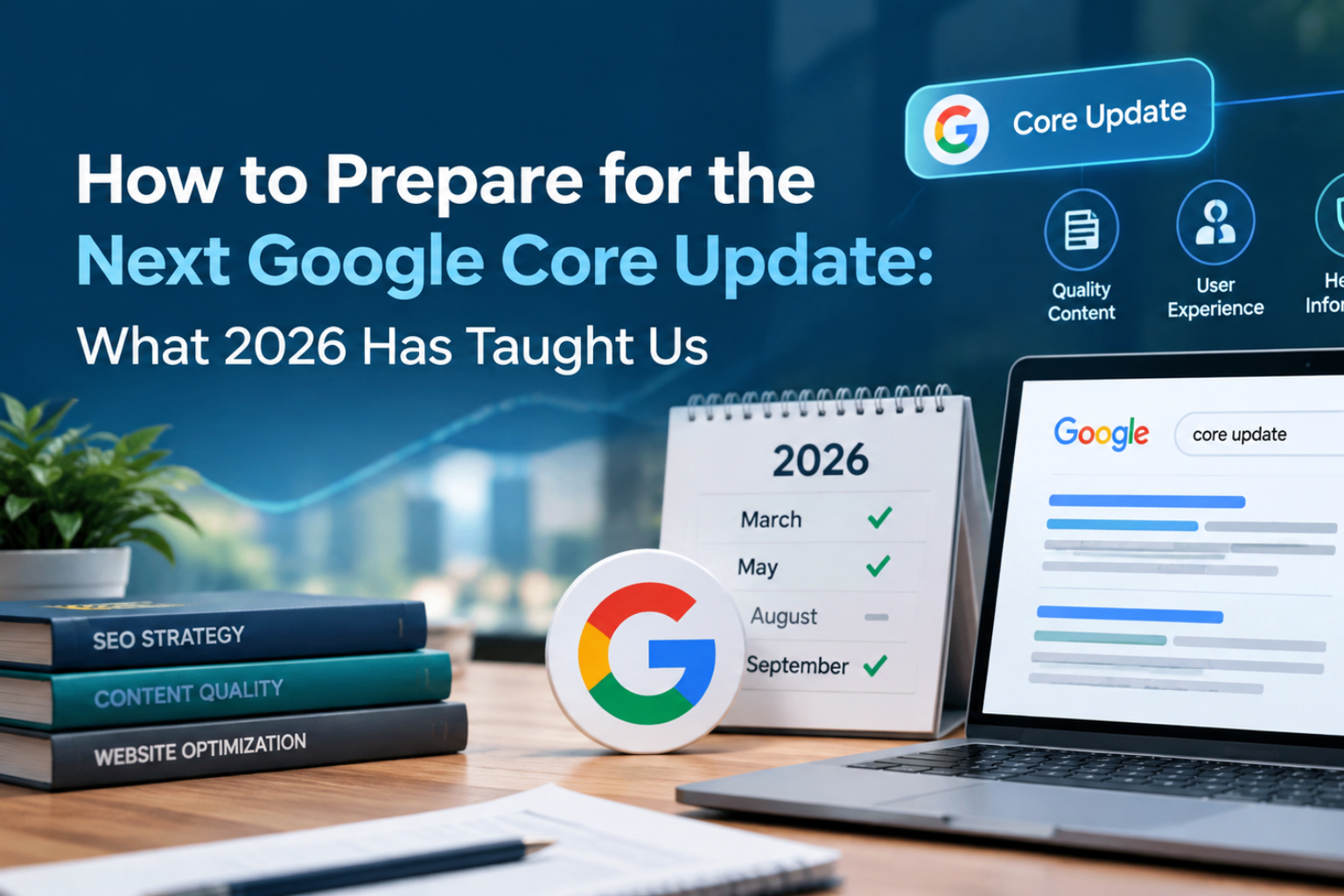
The 2026 calendar makes the point better than any theory could. Google completed core updates in March and May, then followed with spam updates in March, June, August, and September, the last of which took a full two weeks and finished rolling out on October 8. The core update many in the industry expected in August never arrived, and as of late October there has still been no confirmed broad core update since the May rollout ended on June 2. Businesses that spent the summer bracing for a specific date were preparing for a calendar Google never published.
That is the lesson of the year. Preparing for Google should not mean predicting the month of the next algorithm change. The stronger strategy is to make your website harder to disrupt whenever the next core update arrives.
Core Updates Are Reassessments, Not Traditional Penalties
When rankings decline after a core update, business owners often assume something must be wrong with the website. That is not necessarily the case. Google explains core updates by comparing them to revisiting a list of favorite restaurants. Some move higher because better alternatives have become available, and a restaurant that moves down is not automatically bad.
Search works the same way. A page that ranked third before an update may move to seventh because competing pages now provide more complete information, demonstrate stronger expertise, satisfy the search intent more fully, or offer a more useful experience. That means the most productive pre-update question is not, “What does Google want me to change before the next update?” It is, “If Google reassessed my website today against the strongest alternatives available, where would we be vulnerable?”
Start With the Pages That Matter Most to the Business
A readiness review should begin with a short list of pages, usually five to ten, but importance should not be defined by traffic alone. A blog article may receive thousands of visits while producing almost no revenue, while a lower-traffic service page generates some of the company’s most valuable phone calls or consultation requests. The first stage of any review should identify pages by business importance as well as search visibility.
For a law firm, those are usually the high-value practice area pages. For an ecommerce business, they are the product categories responsible for substantial organic revenue. A dental practice may prioritize treatment pages, while a contractor focuses on the services that consistently generate qualified local inquiries. Once those pages are identified, evaluate each one from the perspective of someone comparing it with the strongest competing results.
Does the page fully answer what the visitor came to learn? Does it demonstrate meaningful experience? Is the information current, and is the next step clear? Does the content provide anything competitors do not?
Content Quality Requires More Than Updating Publication Dates
Older content deserves attention, particularly when the subject changes over time, but age alone does not make content weak. A five-year-old explanation of a stable concept may still be completely accurate, while a six-month-old article about an evolving Google feature could already be outdated. Freshness should be judged on whether the information itself remains useful.
Google’s guidance on creating helpful, reliable, people-first content asks whether a page provides original information, substantial coverage, first-hand expertise, and a satisfying experience. It also warns against producing large amounts of content mainly to attract search traffic or summarizing what other sources already say without adding meaningful value.
Review outdated statistics, obsolete recommendations, old screenshots, discontinued services, broken links, and sections that no longer match how customers make decisions. Expand content when something meaningful is missing, but do not add paragraphs simply to make an article longer. Updating the date without substantially improving the page provides very little value. At LAD Solutions, we treat content updates as opportunities to make a resource better than the version already ranking, not as a way to make the page appear newer.
E-E-A-T Should Be Demonstrated Through the Content
Experience, Expertise, Authoritativeness, and Trustworthiness, commonly known as E-E-A-T, come up in nearly every core update conversation, and businesses should be careful not to turn the concept into another checklist. Google states that E-E-A-T itself is not a specific ranking factor. Its systems use multiple signals that can identify qualities associated with experience, expertise, authority, and trust, and Google says trust is the most important element of the framework.
The practical implication is that a business should make its real expertise easier to recognize. A contractor can explain issues encountered during actual projects. A dentist can provide clinically reviewed educational information. A law firm can make attorney experience and authorship transparent. An ecommerce company can contribute first-hand product comparisons rather than rewriting manufacturer descriptions.
As AI makes generic content inexpensive to produce, the websites most resilient to future updates are the ones contributing information rooted in genuine knowledge, original experience, and useful analysis that cannot be reproduced by summarizing competing pages.
Technical Health Supports Rankings but Cannot Protect Them
Technical performance belongs in core update preparation, but it needs to be kept in perspective. Google says there is no single page experience signal and that perfect scores do not guarantee higher rankings. Core Web Vitals measure three separate things: Largest Contentful Paint for loading, Interaction to Next Paint for responsiveness, and Cumulative Layout Shift for visual stability. They are diagnostic tools, not algorithmic targets.
That does not make technical work unimportant. A slow website frustrates users, layout shifts make buttons difficult to tap, and poor mobile usability reduces conversions. Broken internal links, crawlability problems, incorrect canonicals, accidental no index directives, or JavaScript rendering issues can prevent strong content from performing as well as it should.
Structured data deserves the same realism. Organization, LocalBusiness, Article, Product, and Breadcrumb schema can help Google understand the meaning and relationships within a site, but schema is not protection against a core update. Google has said the same about its generative AI features: established SEO fundamentals apply, and no special AI-specific technical tricks are required. Verify that markup is accurate and matches visible content, then move on to the work that actually moves rankings.
A Baseline Turns Ranking Panic Into Diagnosis
Document performance while nothing is happening. Without a baseline, businesses rely on memory. They remember that traffic “used to be higher” or that a keyword “was always number one,” but they cannot say when the change occurred, which pages were affected, or whether leads declined at the same time.
Google Search Console provides the starting point. Track important pages, queries, clicks, impressions, and average positions, then combine that with GA4 conversion data, call tracking where appropriate, ecommerce revenue, and lead quality. Ranking movement alone does not always indicate a serious problem. Google specifically advises against drastic action for small movements and recommends a deeper assessment only when the decline is sustained and large. Good baseline data lets you tell those two situations apart.
Consider a dental practice in Orange County that sees organic traffic fall twelve percent in the week after an update. Without a baseline, that looks like a crisis. With one, the practice can see that the drop came entirely from three informational blog posts while its implant and Invisalign pages held their positions and consultation requests stayed flat. That is not an emergency. It is a content refresh project for three articles, scheduled calmly.
Continuous Improvement Beats Pre-Update Panic
A common mistake is waiting until Google announces a core update before reviewing the website, because by then the rollout is already happening. Google clarified in 2026 that it continually makes smaller core updates that are not individually announced, and that sites which have improved can see gains from those updates without waiting for a named one. The quiet stretch since June proves the point. Rankings have continued to move all summer and fall with no announced core update behind the movement, which is why preparation belongs in normal SEO maintenance rather than on a calendar.
When an update does begin, patience becomes part of the strategy. Google recommends waiting at least a full week after a rollout completes before analyzing Search Console, and comparing a post-update week with a comparable week before the rollout started. Making major changes during the volatility creates an attribution problem, because if performance shifts again you cannot tell whether the algorithm or your edits caused it. Once enough data exists, look for patterns. Did the whole site decline or only one content type? Did clicks fall while conversions held? Those questions lead to diagnosis.
Frequently Asked Questions About Google Core Updates
How often does Google release core updates?
Google says significant core updates occur several times per year, but there is no fixed schedule businesses should rely on. In 2026 there were two in the first half of the year and none in the four months that followed. Smaller core changes also happen continuously and are not publicly announced.
Should businesses stop publishing content during a core update?
No. There is no reason to pause normal publishing or legitimate website improvements. The greater concern is making large reactive changes solely because rankings temporarily moved during an active rollout.
Can a website recover without waiting for another major core update?
Yes. Google says some improvements can take effect within a few days, although it may take several months for its systems to confirm that a whole site has improved. Smaller unannounced core updates can also recognize improvements before the next named update.
Should businesses delete pages that lose rankings after an update?
Usually not as a first response. Google describes deleting content as a last resort for pages that cannot be salvaged. Businesses should first determine whether the page remains useful and whether rewriting, restructuring, consolidating, or expanding it would better serve users.
Does AI-generated content make a website more vulnerable to core updates?
Using AI does not automatically make content low quality. The greater risk is publishing large amounts of generic, inaccurate, repetitive, or search-first content without meaningful human expertise or editorial oversight. The same quality standards apply regardless of how the first draft was created.
Core Update Readiness Is Really Website Quality Readiness
There is no reliable way to predict when Google’s next major core update will arrive or which websites will gain and lose visibility, and 2026 has shown that even confident industry predictions can miss by months. Fortunately, businesses do not need to predict it. The strongest preparation is maintaining useful content, demonstrating genuine expertise, keeping important information current, resolving technical problems, and measuring search performance against actual business outcomes.
At LAD Solutions, we help businesses evaluate SEO performance across content quality, technical health, local visibility, AI search readiness, and conversion performance so decisions are based on evidence rather than algorithm speculation. If you want to know whether your website is ready for Google’s next ranking update, call 844.523.2556 or visit www.LADSolutions.com to schedule a consultation and identify the pages that deserve attention before rankings begin moving.