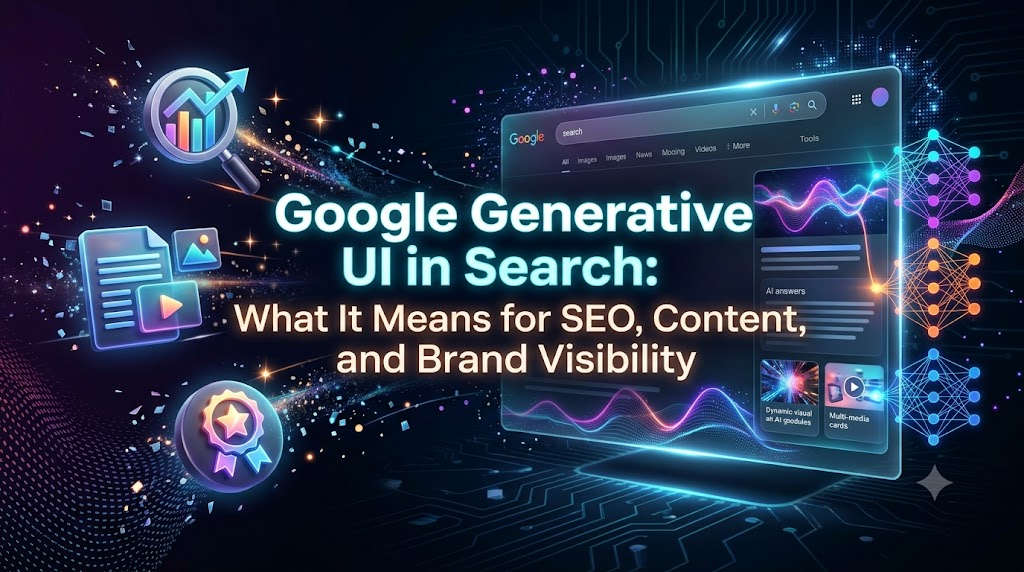
For years, businesses have optimized websites around a familiar assumption: Google helps people find the right page, and the website provides the experience. Generative UI begins to change that relationship. Instead of sending a user to a website containing a calculator, comparison table, or interactive tool, Google Search can increasingly build parts of that experience inside the search result itself. A user researching mortgage options might receive an interactive calculator. Someone trying to understand a scientific concept might receive a simulation.
Google first introduced generative UI in AI Mode with Gemini 3 in late 2025. At Google I/O 2026, the company expanded the concept by bringing Google Antigravity and the agentic coding capabilities of Gemini 3.5 Flash into Search. Google said Search could assemble custom layouts with interactive visuals, tables, graphs, and simulations, help build dashboards and trackers for ongoing tasks, and eventually create mini apps, starting with subscribers.
For marketers and business owners, the important question is not whether this technology is impressive. It is what happens to website visibility when Google can create the experience a user needs without that person ever visiting the website that historically provided it.
Generative UI Changes the Search Result From an Answer Into an Experience
AI Overviews already changed search by letting Google synthesize information from multiple sources before a user clicks a traditional result. Generative UI takes that further. Instead of only generating text, Search can decide which format would best help the user understand or act on the information, then assemble images, tables, grids, interactive tools, or simulations to fit the question.
Imagine someone comparing two financing options. Historically, Google returned several articles and loan calculators, and the user chose a website, entered information, and evaluated the result there. With generative UI, Search may build the comparison tool directly within AI Mode.
This does not make websites unnecessary. Google’s generative AI experiences continue to include links to web content, and Google says AI Search is designed to connect people with relevant websites. But it does mean more of the research process can happen before the click, which makes the quality of the visibility a business earns increasingly important.
Google Has Not Published a Generative UI Optimization Formula
Whenever Google introduces a new search experience, an optimization industry appears immediately, and generative UI will be no different. Businesses will hear that they need special schema, particular table structures, or specific content layouts to become a source for Google’s generated interfaces. Google has not published evidence supporting any of those claims. Its official guidance for generative AI Search continues to emphasize established SEO principles.
Google’s generative AI features draw on the Search index and rely on core ranking and quality systems to retrieve relevant, current pages. Google describes techniques such as query fan-out, in which the system performs related searches to gather enough information to answer a complex question. There is no confirmed “generative UI schema,” no WordPress plugin that guarantees inclusion, and no documented rule that a page containing a table will be selected over a page written in paragraphs. The right strategy is not to redesign every page around an unproven algorithm but to strengthen the qualities Google has actually said matter.
Original Information Becomes More Valuable When AI Can Recreate Generic Content
Generic information is becoming easier for search engines to reproduce. If twenty websites explain the same basic concept, an AI system can synthesize that information without sending a user to any of them. The strategic value shifts toward information that is hard to reproduce without referring to the original source. Google’s own AI Search guidance emphasizes unique, useful, non-commodity content and encourages publishers to contribute first-hand experience rather than repeating what is already available.
Consider a hard money lender that has ranked for years with a page explaining how bridge loan interest is calculated, complete with a simple calculator. Generative UI can build that calculator inside Search for any user who asks. What it cannot build is the lender’s actual rate ranges by property type and loan-to-value, its real closing timelines from recent deals, or an explanation of the three situations where a bridge loan is the wrong product. A page built around that information remains worth citing and worth visiting. A page built around the generic calculator does not.
The same principle applies to law firms, dental practices, contractors, ecommerce businesses, and every other category. As AI gets better at synthesizing common knowledge, the incentive to publish information that only you could have written grows every quarter.
Structure and Schema Should Serve Readers, Not an Imagined Algorithm
A common recommendation is to use more tables and lists because generative UI might find those formats easier to extract. That is plausible, but Google has not confirmed it as an optimization factor. There is still a good reason to structure information clearly: people benefit from it, and Google’s AI Search guidance specifically recommends organizing pages with useful sections and descriptive headings.
The format should follow the information. A business should not convert thoughtful explanations into tables because someone claims AI prefers tables or turn an article into endless bullet points to make it “AI friendly.” At LAD Solutions, we treat structure as a communication decision first. The easier it is for a customer to understand the page, the easier it generally is for search systems to interpret its purpose and relationships.
Schema markup deserves the same realism. Structured data helps Google understand supported content types such as products, organizations, local business details, and articles, which makes it a legitimate part of technical SEO when it accurately reflects the visible page. But Google’s current guidance does not identify any structured data as a requirement for appearing in its generative AI experiences. Adding unsupported markup because it might influence an AI response creates complexity and potentially conflicting information. Structured data should clarify reality, not manufacture signals.
Useful Visuals Create Additional Visibility Opportunities
Generative UI is inherently visual, which makes another part of Google’s guidance relevant. Google encourages publishers preparing for generative AI Search to consider useful images and video alongside written content, because its AI experiences can surface multimedia as part of a response. That does not mean adding stock photography to every article. A contractor explaining a complex installation benefits from original project photographs. An agency can publish a visualization showing how a client’s visibility changed across an algorithm update. The important word is useful. Visual content should contribute information rather than decorate the page.
Visibility Now Has to Be Measured Beyond the Click
If Search answers more complicated questions directly, website traffic will not capture every meaningful brand interaction. A user might encounter a company’s name inside an AI-generated research experience, remember it, and search for the brand a week later. In 2026, Google added a generative AI performance report to Search Console that shows impressions from AI features in Search and Discover. Google completed the global rollout of that report and a related control on August 31. The report has no click or query data, so it tells you where you appeared, not what it produced.
The same rollout added a Search generative AI control that lets site owners block their content from AI Overviews and AI Mode. Most businesses should leave it alone. Opting out removes you from the experience where a growing share of research now happens, and it does nothing to improve your traditional rankings. Businesses should instead evaluate AI visibility alongside impressions, clicks, branded searches, AI referral traffic, conversions, and lead quality. Attribution remains imperfect, which makes longer-term trends across several metrics more useful than whether one query produced one citation on one day.
Your Website Still Has to Earn the Visit
The most important strategic question is what happens when a user finally does click. If Google can answer basic questions, run simple comparisons, and build certain tools inside Search, the people who reach a website are looking for something more specific: deeper expertise, evidence, proprietary information, a professional opinion, personalized help, or the ability to take action. For a law firm, that is understanding a visitor’s specific circumstances. For a dental practice, it is a clinical evaluation. For an ecommerce business, it is the product and the buying experience. Fewer but more informed visitors should encounter clear positioning, strong trust signals, useful evidence, and an obvious next step, which is why website design and conversion rate optimization are now tied directly to AI search performance.
Generative UI also rewards businesses that think beyond individual pages. A company that is repeatedly associated with a subject across its own website, reputable third-party sources, reviews, media coverage, and professional profiles has a stronger digital footprint than a business trying to rank one isolated page. The underlying principle will hold: give search systems and customers clear evidence of who your business is, what it knows, and why its information can be trusted. That is more sustainable than reverse engineering the latest interface.
Frequently Asked Questions About Google Generative UI
Is generative UI the same as Google AI Overviews?
No. AI Overviews generate synthesized answers with supporting links, while generative UI builds customized visual layouts and interactive elements such as tables, simulations, or tools. Both are part of Google’s broader shift toward generative AI search experiences, and Google has merged AI Overviews and AI Mode so users can move from a results page into follow-up questions.
Can businesses optimize specifically for generative UI?
Google has not published a dedicated generative UI ranking or optimization system. The safest approach is to follow Google’s established guidance for generative AI Search: strong SEO fundamentals, useful original content, clear site architecture, crawlability, and relevant multimedia.
Will adding more tables improve my chances of appearing in generative UI?
There is no official Google guidance stating that tables increase the likelihood of being selected. Use tables when they help readers understand comparisons, specifications, or structured information, and use prose where explanation is needed.
Is generative UI available to everyone or only paid subscribers?
Google said at I/O 2026 that generative UI was rolling out to Search for everyone free of charge over the summer, while mini apps would arrive in the following months starting with subscribers. Availability varies by region and feature, so what a business sees in its own market may differ from the demonstrations.
How should businesses measure generative AI visibility?
Use Google’s generative AI performance report in Search Console alongside traditional impressions, clicks, rankings, branded searches, AI referral traffic, conversions, and lead quality. Because the report shows impressions only and attribution is incomplete, trends across multiple metrics are more useful than any single number.
Search Is Becoming an Interface, Not Just a List of Results
Generative UI represents a larger change than another redesign of Google’s results page. Search is becoming capable of creating the experience a user needs at the moment they ask, whether that is an explanation, a comparison, a simulation, a calculator, or a tracker. Businesses should take that seriously without turning it into another collection of speculative tactics. There is no confirmed generative UI optimization formula today. What businesses control is the originality of their information, the technical accessibility of their website, the clarity of their content, their broader brand authority, and the value their site provides when someone chooses to visit. Generative UI makes those fundamentals more important, not less.
LAD Solutions helps businesses prepare for the evolving search landscape through SEO, AI search optimization, content strategy, structured data, conversion rate optimization, and website development. If you want to know whether your website is positioned for both traditional search and Google’s expanding AI experiences, call 844.523.2556 or visit www.LADSolutions.com to schedule a consultation.