
A business can publish hundreds of pages, target the right keywords, build backlinks, and still struggle to earn meaningful visibility if search engines cannot confidently understand who is behind the information or why that source should be trusted. That challenge has grown in 2026, because Google is no longer the only system evaluating online information. Businesses are also trying to appear in Google AI Overviews, AI Mode, ChatGPT, Gemini, and Perplexity, all of which must decide which sources are credible enough to summarize or recommend.
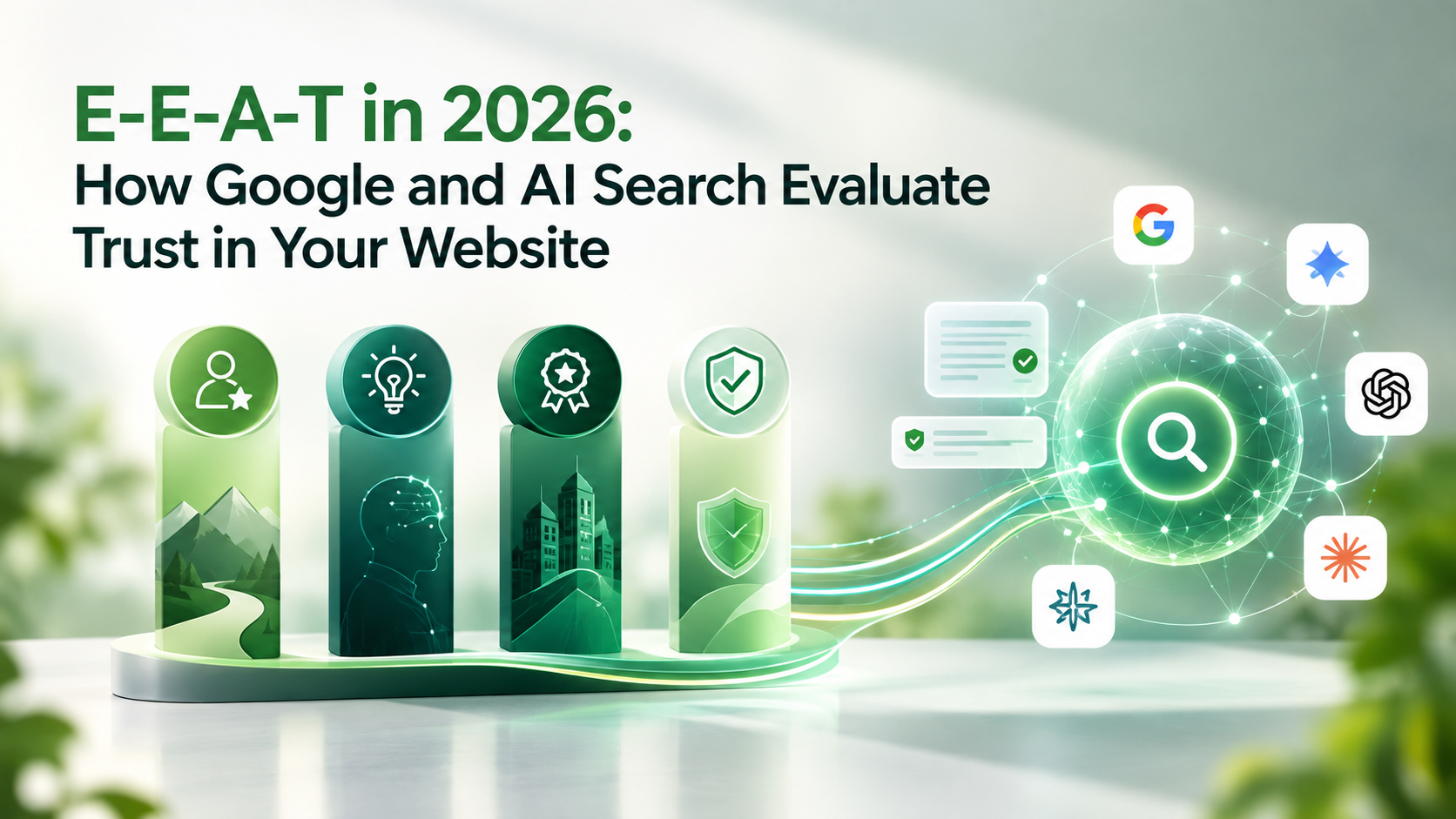
This is where E-E-A-T matters. It stands for Experience, Expertise, Authoritativeness, and Trustworthiness, and Google uses these concepts within its Search Quality Rater Guidelines and its guidance on helpful, reliable, people-first content to describe what makes information credible. E-E-A-T is not a single ranking factor or a score a business can improve by checking a few boxes; it is a framework for understanding the signals that make information, and the organizations behind it, more trustworthy. For business owners, that distinction matters. The goal is not to optimize an E-E-A-T score but to build a digital presence that gives customers, search engines, and AI systems legitimate reasons to trust your business.
E-E-A-T Is a Trust Framework, Not a Single Google Ranking Factor
One of the biggest misconceptions about E-E-A-T is that Google assigns every website a score that directly determines rankings. That is not how Google describes it. Quality raters use E-E-A-T concepts when evaluating search results, and their evaluations help Google understand whether its systems are producing useful results, but the raters do not directly change rankings. The practical lesson still matters, because the characteristics of strong E-E-A-T are the same things people want from a trustworthy source: who created the information, whether they understand the subject, whether the company has relevant experience, whether credible sources recognize it, and whether the information is accurate.
Those questions carry extra weight when content can influence a person’s health, finances, legal decisions, or safety, subjects Google calls Your Money or Your Life, or YMYL. A hard money lender explaining loan terms carries a different responsibility than a blog reviewing office furniture. A personal injury firm explaining a client’s legal rights should make authorship and qualifications clear, and a senior living community or dental practice publishing health related guidance should be especially careful about accuracy and review. Every business benefits from trust, but the level of scrutiny varies with the subject matter.
Experience Shows the Content Comes From Real World Knowledge
Experience refers to firsthand familiarity with the topic, and it became an explicit part of the framework when E-A-T became E-E-A-T. The distinction is useful because someone can understand a subject academically without ever having performed the work or encountered its practical challenges. Consider two articles about managing Google Ads. One explains what keywords, bidding, and conversion tracking are by summarizing information available elsewhere. The other explains why businesses misread lead quality when they increase ad spend, how conversion tracking problems distort campaign decisions, and what to evaluate before blaming the bidding strategy. Both may be accurate, but the second demonstrates practical experience that surface level research cannot reproduce.
Businesses can demonstrate experience through case studies, original observations, before and after examples, project photographs, and lessons learned from actual work. The important thing is not to manufacture it. If a company has not personally tested something, it should not imply it has, and credibility strengthens when a business clearly separates what it has observed, what established sources report, and what it believes based on professional analysis. At LAD Solutions, this is one reason we place so much value on practical explanations: a business owner should come away understanding not only what a marketing concept means, but why it matters in real campaigns and where businesses commonly go wrong.
Expertise Comes From Depth, Accuracy, and Transparent Authorship
Expertise is related to experience but not identical to it. Experience shows that someone has dealt with a subject firsthand; expertise shows that the person or organization understands it deeply enough to explain it accurately, recognize the nuances, and provide useful guidance. Surface level content usually becomes obvious the moment a reader reaches a harder question. An article may say that website speed matters for SEO, but expertise shows when the content explains how performance affects users, why mobile conditions matter, and why a better speed score does not automatically improve conversions. Expert content does not need to sound academic; a law firm blog need not read like a legal textbook, and strong expertise often shows in making complicated subjects easier to understand.
Authorship is where expertise becomes visible. Adding an author biography is one of the most common E-E-A-T recommendations, but a name beneath an article does not by itself make the content more trustworthy; the biography should explain why that person is relevant to the subject, through professional experience, credentials where applicable, and a link to a fuller profile. Some content is rightly published under an individual expert, while other content represents the collective knowledge of the company, and the right choice depends on who is actually responsible for the information. Creating fake experts or adding credentials for SEO defeats the purpose.
Authoritativeness Depends on Recognition Beyond Your Own Website
Any company can describe itself as an industry leader, and search engines and customers have far stronger reasons to believe it when credible third parties recognize the business as well. That is the essence of authoritativeness. Relevant backlinks remain one form of external recognition, but authority is broader than link building; industry publications, professional associations, media coverage, expert interviews, research citations, legitimate directories, awards, customer reviews, and community discussions all contribute to a fuller picture of the brand.
This is where businesses should think beyond traditional SEO, because AI systems work across multiple sources when forming answers. If a company is consistently associated with a particular expertise across its own website, respected publications, reviews, and professional profiles, that creates a coherent digital footprint, whereas a website making impressive claims that no independent source repeats leaves those claims unsupported. Authority cannot be built entirely on your own website. Legitimate public relations, reputation management, quality link acquisition, and industry participation complement an SEO strategy, and the objective is not to manufacture hundreds of mentions but to strengthen the connection between the expertise a company claims and the external evidence supporting it.
Trustworthiness Connects the Entire Framework
Trust is the foundation holding the other elements together. A business can demonstrate experience, expertise, and recognition and still create uncertainty if its website contains inaccurate information, unclear authorship, exaggerated claims, broken contact details, or poor security practices. For customers, trust starts with basic questions: is this a real organization, can I identify the people behind it, is the contact information accurate, and are the claims supported. Different businesses need different trust signals. A local service business benefits from consistent contact information, genuine reviews, visible licensing, and clear service areas, while a professional service firm needs attorney, physician, or specialist bios that explain credentials, and HTTPS, functioning forms, and clear privacy practices belong in the conversation too.
Consistency is part of trust as well, because search systems need to understand the organization behind the website clearly. A company should not have one phone number on its site, another in an old directory, and outdated services on third party profiles; for local businesses, consistent name, address, and phone information across Google Business Profile, directories, and review sites remains particularly important. Structured data can help search engines understand the relationships between a business, its people, services, and locations, but schema is not an E-E-A-T shortcut and does not create authority by itself. Its value is clarity, which matters more as AI systems connect information across many sources rather than judging isolated pages. Trust is rarely created by one badge or schema property; it is the cumulative result of many consistent signals.
Original Content Strengthens Both E-E-A-T and AI Visibility
Generative AI has made it easy to produce content that sounds polished without contributing anything new, which raises the value of information rooted in genuine experience: original research, proprietary data, case studies, and first hand observations that cannot be recreated by summarizing other websites. That matters for traditional SEO because useful original content earns references and links, and it may matter for AI visibility because AI systems need credible sources to build answers from. There is no guarantee that original research will cause ChatGPT, Gemini, Perplexity, or Google AI Overviews to cite a particular company, since these systems use different models and retrieval methods, but if dozens of websites repeat the same information and one contributes meaningful evidence, that one has created a stronger reason for people and machines to pay attention. Google itself has said that AI assisted content is not automatically spam, and that however content is produced, it should demonstrate E-E-A-T qualities. The strongest trust signals accumulate this way over time, as experts publish useful insights, reviews grow, and credible sites reference the company because it made something worth citing.
Frequently Asked Questions
Does E-E-A-T directly determine Google rankings?
Google does not describe E-E-A-T as a single direct ranking factor or a score. It is a framework used within Google Search Quality Rater Guidelines to evaluate the qualities associated with helpful and trustworthy content, and the raters themselves do not change rankings. Businesses should focus on the underlying principles rather than trying to optimize an imaginary E-E-A-T score, because the principles are what Google systems are designed to reward.
Is E-E-A-T more important for legal, healthcare, and financial businesses?
Trust and expertise matter in every industry, but they become particularly important when content can affect significant health, financial, legal, or safety decisions, which Google calls YMYL topics. Law firms, dental and healthcare providers, senior living communities, and lenders should pay especially close attention to authorship, credentials, sourcing, accuracy, transparency, and content review processes, because scrutiny is higher where the cost of bad information is higher.
Can AI generated content demonstrate E-E-A-T?
AI can assist with research, organization, editing, and drafting, and Google has stated that AI assisted content is not automatically spam. What software cannot do is create first hand business experience that does not exist. Content becomes stronger when knowledgeable people contribute original expertise, verify factual claims, add real examples, and take responsibility for what is published, regardless of which tools helped produce it.
Do backlinks still matter for authority?
Relevant backlinks from credible sources remain valuable because they represent independent recognition and help search engines see relationships between websites. Authority should not be reduced to a backlink count, though. Brand mentions, professional recognition, reviews, citations, and broader industry presence all contribute to how a business is perceived, and a few authoritative mentions usually outweigh a large volume of easily acquired links.
How quickly can a company improve its E-E-A-T signals?
Some improvements happen quickly, such as correcting business information, adding transparent authorship, strengthening About pages, updating outdated content, or improving structured data. Genuine authority takes longer, because it develops through experience, recognition, reviews, relationships, original content, and consistent performance over time. The quick fixes are worth doing; the durable value comes from the slower work.
Building Trust Is Bigger Than Optimizing for an Algorithm
E-E-A-T matters because the principles behind it reflect something more fundamental than SEO. Customers want credible information from real organizations with relevant experience, proven expertise, recognizable authority, and transparent practices, and search engines want the same things. As search expands from traditional results into AI Overviews, AI Mode, ChatGPT, Gemini, and Perplexity, trust and source credibility will only grow in importance. The technologies will keep changing, but expertise, accurate information, original insight, transparent authorship, and legitimate third party recognition keep providing value, which is why E-E-A-T belongs in your broader digital presence rather than on another SEO checklist.
LAD Solutions helps businesses strengthen the foundations that support both traditional SEO and emerging AI visibility, including content strategy, technical SEO, structured data, local SEO, reputation management, website development, and brand authority. Before investing in more content simply to increase publishing volume, it is worth evaluating whether your existing digital presence clearly demonstrates why customers and search systems should trust your business. To discuss your SEO and AI Search Optimization strategy, call 844.523.2556 or visit www.LADSolutions.com to schedule a consultation.