A business owner opens their SEO report and finds several important keywords have suddenly moved. Traffic is up one day and down the next, and a competitor that sat below them is briefly above them. The reaction is almost always the same: what changed, and do we need to start fixing something?
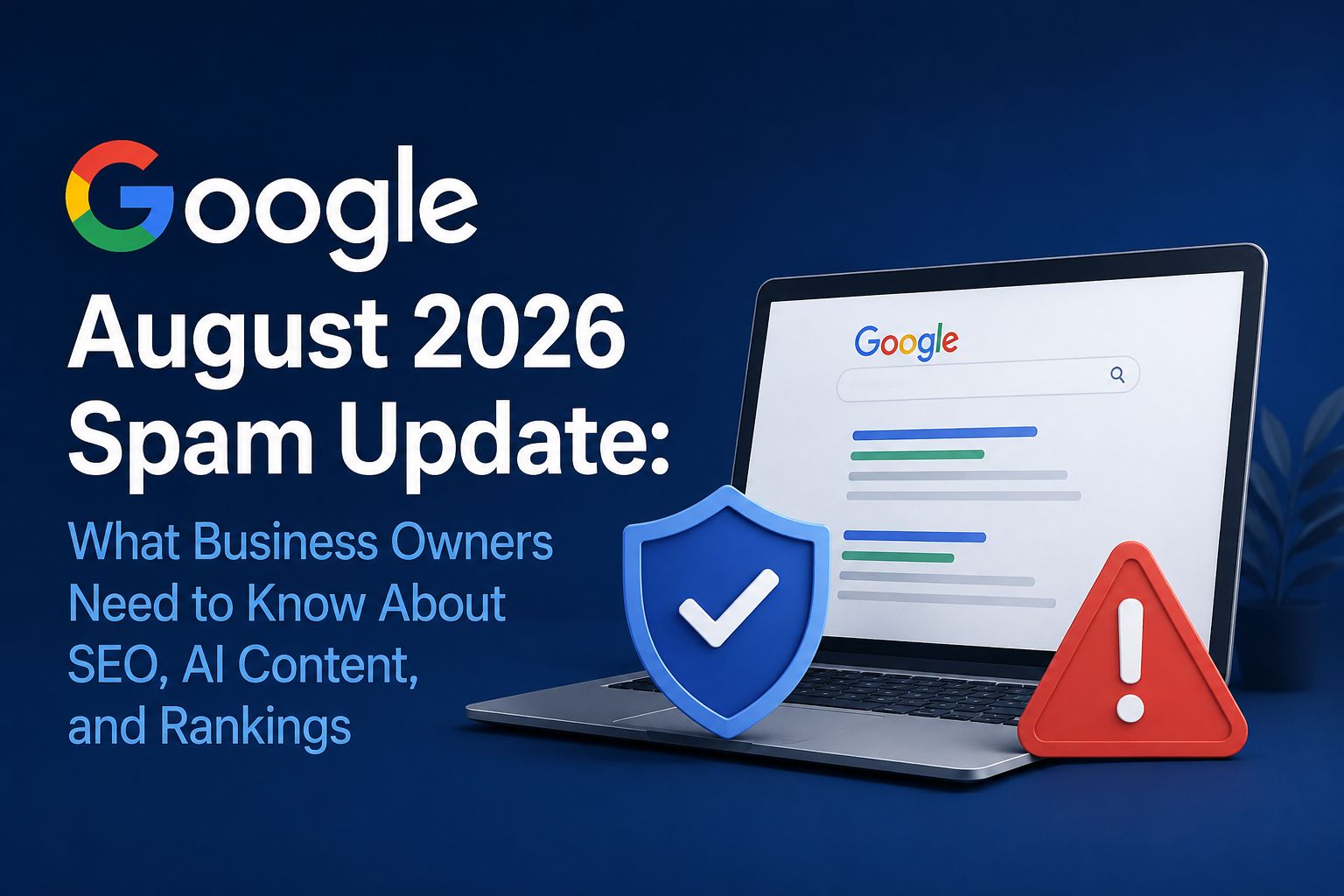
That question became timely today, August 18, 2026, when Google began rolling out its August 2026 spam update. Google confirmed on its Search Status Dashboard that the update applies globally and to all languages and may take a few days to complete. For businesses that depend on organic traffic, the word spam can sound alarming, and it can lead to unnecessary assumptions. A website that sees rankings move during a spam update has not automatically been penalized, and it should not start rewriting pages, disavowing backlinks, or overhauling its strategy simply because positions shifted mid rollout. What the update does offer is a good moment to understand what Google increasingly treats as manipulation, and how legitimate businesses should approach SEO in an environment shaped by AI, automated content, and AI generated results.
The August 2026 Spam Update Is Different From a Core Update
Google releases several kinds of ranking updates, and the distinction matters before you evaluate any change in performance. A broad core update reassesses how Google systems judge which content is most relevant and useful. A spam update has a narrower purpose: it improves the automated systems that identify practices meant to manipulate search visibility rather than genuinely help users. Google spam detection runs continuously, but the company periodically makes larger improvements it calls spam updates. One of the technologies involved is SpamBrain, Google AI based spam prevention system, which it refines to catch existing and emerging forms of search spam.
For a business owner, the distinction shapes the correct response. A site affected by a core update may need stronger content, better alignment with search intent, improved experience, or greater authority. A site affected by spam detection requires a different conversation, about whether some part of its SEO approach conflicts with Google policies, so diagnosis should always come before reaction. It is also worth noting the pace: spam updates in 2026 have tended to roll out quickly, with recent ones completing in days rather than weeks, which makes patient observation over the full rollout more important than reacting on day one.
Google Definition of Spam Is Broader Than Many Businesses Realize
When most owners hear search spam, they picture obviously deceptive sites full of hidden keywords and shady links. Those still exist, but Google current policies cover a far wider range of techniques, including keyword stuffing, link spam, doorway abuse, cloaking, scaled content abuse, expired domain abuse, site reputation abuse, scraping, and hidden text. Some of these can look surprisingly close to legitimate SEO without context.
Consider service area pages. Creating individual city pages can be a perfectly good local SEO strategy when each page offers meaningful information for customers in that market. Creating hundreds of nearly identical city pages that exist mainly to capture keyword variations moves much closer to what Google calls doorway abuse. The dividing line is not whether a technique counts as SEO. It is whether a page exists primarily to help a user or primarily to manipulate a search engine, and that question is becoming more important as Google gets better at evaluating intent and quality at scale.
The Update Makes AI Content Quality Especially Important
A common question is whether the August 2026 spam update targets AI generated content. Google has not said that it specifically targets AI content, and you should be cautious about anyone claiming otherwise while the rollout is still active. More importantly, Google published policies do not treat using AI to assist with content as automatically spam. The problem Google names is scaled content abuse, which it describes as generating large amounts of unoriginal or low value content primarily to manipulate rankings.
That distinction is everything. A business might use AI to help with research, organize ideas, or accelerate a draft while experienced people review, expand, fact check, and improve the final article. That is fundamentally different from auto generating hundreds of generic pages because software makes it cheap. The better question is not whether AI was used to create something. It is whether the content would deserve to exist if Google rankings did not. If an article genuinely educates customers, demonstrates expertise, and helps someone decide, it has a purpose beyond manipulating search. If a page exists only to capture another keyword variation, that is worth questioning, and that principle will hold long after this update completes.
Backlinks Still Matter, but How They Are Earned Matters More
Spam updates also make businesses nervous about links, which is understandable because Google includes link spam in its policies. It would be a mistake, though, to conclude that backlinks are becoming irrelevant. Links remain an important way authority and relationships across the web are understood. The problem is links created primarily to manipulate rankings rather than earned through genuine visibility, relationships, editorial coverage, or useful resources. Google specifically names buying or selling links, excessive exchanges, automated link creation, low-quality directory links, and certain optimized links placed in paid or widely syndicated articles.
This is an area where owners should evaluate SEO providers carefully. A monthly report showing hundreds of new backlinks can look impressive while telling you very little about whether those links help. A handful of authoritative, contextually relevant mentions often deliver more long-term value than large volumes of easily acquired links. A durable link strategy increasingly resembles legitimate brand building, where industry coverage, useful research, respected directories, professional associations, editorial mentions, strong content, and authentic digital PR create signals that matter beyond any single algorithm.
Avoid Making Major Changes While the Update Is Rolling Out
Perhaps the most useful thing to do in the first days of the update is to avoid panicking. Ranking volatility during an active rollout does not give you enough information to diagnose a problem, because results move while Google systems reassess and can keep moving until the rollout completes. Instead, establish a baseline. Review Google Search Console performance from before the update began and document the changes in impressions, clicks, queries, and landing pages, paying attention to whether the movement affects the whole site or specific kinds of pages.
The pattern is what matters. A few blog articles moving temporarily while your service pages hold steady tells a very different story from a sitewide decline across commercial keywords, and a site with hundreds of auto generated location pages deserves a different read from a small business site with twenty carefully built pages. One of the most common mistakes we see around major updates is businesses making several changes at once, rewriting content, changing titles, removing links, altering internal linking, and redesigning pages together. Even if rankings improve afterward, there is no reliable way to know which change helped. Good SEO decisions require enough data to understand the problem before choosing the solution.
Google Spam Policies Now Reach Into AI Search
This update also matters for businesses thinking beyond traditional rankings, and it is the part most relevant to anyone investing in AI visibility. In May 2026, Google rewrote the opening definition in its spam policies so that spam now explicitly includes attempting to manipulate generative AI responses in Google Search, a definition that covers AI Overviews and AI Mode alongside classic rankings. The August update enforces policies that now include the answer layer, using the same mechanisms of algorithmic demotion through SpamBrain and, where needed, manual action.
That should reinforce something businesses ought to be considering as generative engine optimization becomes a larger part of marketing: AI visibility is not a new loophole. Creating hundreds of pages to manufacture AI citations, stuffing pages with questions aimed only at AI systems, or producing low value content at scale is not a sustainable strategy, and it now carries explicit policy risk. The same principles that support strong traditional visibility increasingly apply to AI Overviews and other AI experiences. The objective should not be tricking artificial intelligence into mentioning your business; it should be giving AI systems legitimate reasons to treat your business as a reliable source, which means genuinely useful content, firsthand expertise, accurate business information, real brand authority, and sound technical SEO.
Frequently Asked Questions
How long will the August 2026 Google spam update take?
Google announced that the update began on August 18, 2026 and said the rollout may take a few days to complete, applying globally and to all languages. Recent 2026 spam updates have tended to finish quickly, sometimes within a day or two, but you should still avoid drawing conclusions from short term ranking fluctuations while the rollout remains active. Wait until Google marks it complete before assessing the real impact.
Does a ranking drop during the update mean Google considers my website spam?
No. A ranking change alone does not prove Google has flagged your site as spam. Results can fluctuate during updates for many reasons, including competitors moving. Spam updates are algorithmic and do not generate a notice in Search Console, so evaluate performance after the rollout completes and look for a meaningful, concentrated pattern before deciding whether any corrective action is actually needed.
Should businesses stop using AI to create content?
Not because of this update. Google policies focus on scaled content produced primarily to manipulate rankings while providing little value, regardless of how it was made, and Google does not treat AI assisted content as automatically spam. Businesses using AI should keep strong editorial oversight, accuracy, originality, and genuine usefulness, and should avoid publishing raw, unreviewed output at scale, which is the behavior these policies target.
Should I remove backlinks if my rankings decline?
Not automatically. A ranking decline does not prove backlinks caused it. Evaluate the quality and origin of your link profile first and determine whether any practices conflict with Google link spam policies before making significant changes. Disavowing hastily can remove links that were helping, so this is a step to take deliberately and with evidence rather than as a panic reaction.
How quickly can a website recover if it was affected by a spam update?
There is no universal timeline. Google explains that once violations are corrected, its automated systems may need to observe compliance over a period of months before improvements appear, and recovery does not depend on waiting for another update. Where link spam is involved, neutralizing manipulative links can mean the ranking benefit they previously provided cannot simply be regained, so the honest expectation is months of consistent, legitimate work rather than a quick reversal.
Sustainable SEO Is Becoming More Important, Not Less
The August 2026 spam update should not push legitimate businesses to abandon SEO tactics that genuinely improve their websites. It should encourage them to examine whether their strategies create real value or merely try to manufacture visibility. Strong SEO still depends on understanding customers, creating useful content, maintaining a technically sound website, earning legitimate authority, and measuring performance carefully. AI has changed how quickly content can be produced and how customers search, but it has not changed the fundamental importance of trust, and Google decision to extend its spam policies into AI answers only underlines that.
The safest response to any Google update is a data driven one. Understand what changed, evaluate why it changed, and make improvements based on evidence rather than reacting to speculation or chasing the latest shortcut. Businesses that operate this way tend to hold steady through the volatility that unsettles everyone else, because they were never depending on the tactics an update removes.
If your website sees significant ranking or traffic changes during the August 2026 Google spam update, call LAD Solutions at 844.523.2556 or visit www.LADSolutions.com to schedule an SEO consultation. We will evaluate your content, backlinks, technical SEO, and AI visibility, tell you honestly whether meaningful changes are needed, and help you build a stronger long term search presence rather than a short-term fix.