Most mid-year marketing audits are performed in a spirit of mild guilt. You know you should look, you suspect the numbers will be worse than you would like, and looking properly takes a day you do not have. So, the audit becomes a quick glance at the traffic graph, a note to self that the blog has gone quiet since March, and a promise to sort it out in Q3.
This year that instinct is more expensive than usual, because the first half of 2026 genuinely moved the ground. Google shipped two core algorithm updates, in March and again in May. It published its first real documentation on how its AI features choose sources and used it to tell the industry that several popular optimization tactics do nothing. AI Mode passed a billion monthly users, which Google confirmed at I/O in May. Paid search economics shifted underneath advertisers who did not change a single setting. A strategy set in January is not merely stale at this point; parts of it may be aimed at a search results page that no longer exists in the same form.
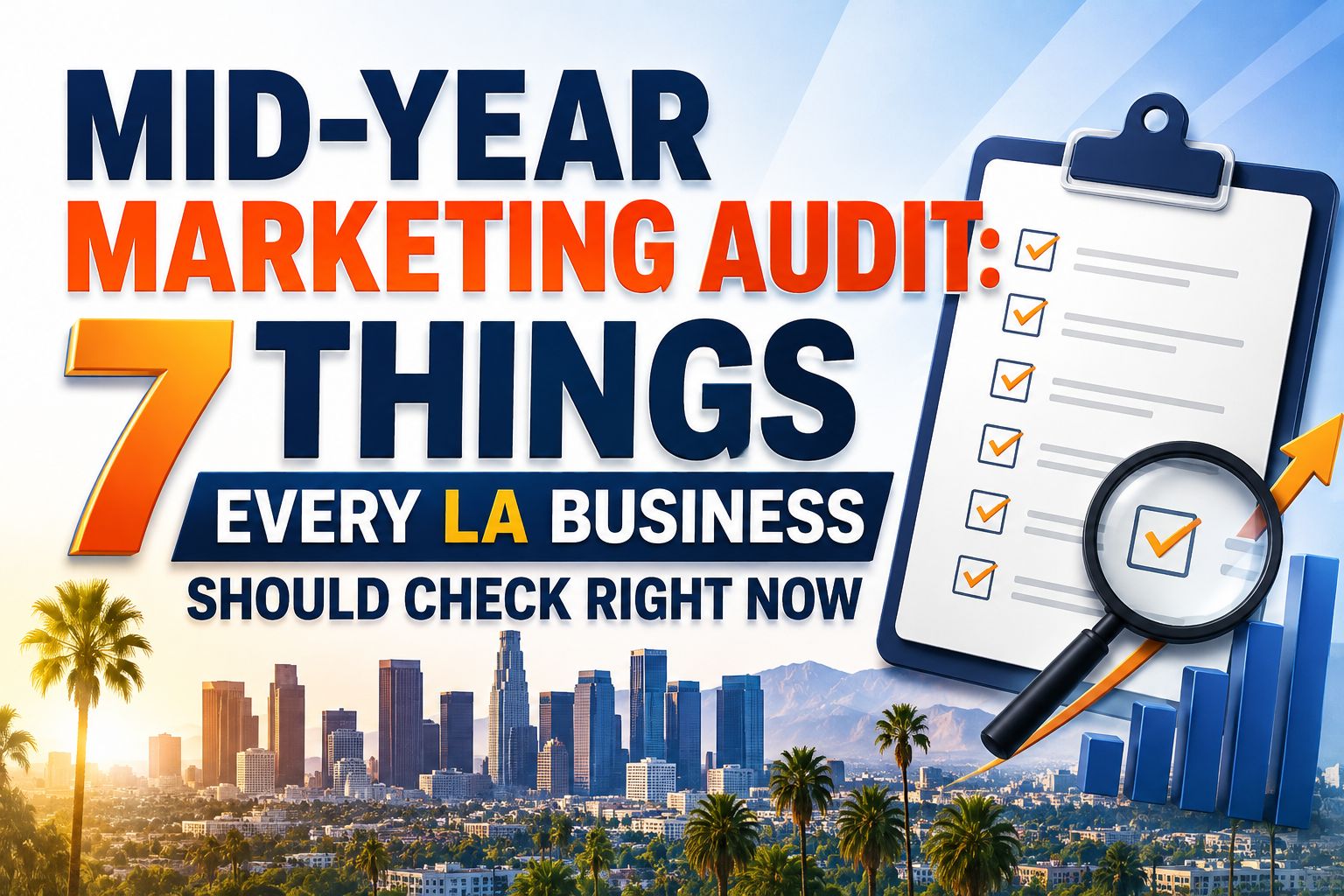
What follows is the mid-year marketing audit we actually run for clients across Los Angeles, in roughly the order we run it. It should take a focused afternoon, not a quarter, and the point is not to fix everything. The point is to find out which two or three things are genuinely costing you money before Q3 disappears the way Q2 did.
1. Check Whether Your Core Update Exposure Is Real
Start here rather than with anything AI related, because this is the check most likely to surface a large, fixable problem. Two confirmed core updates landed this year, the March update running from March 27 to April 8 and the May update from May 21 to June 2. Open Google Search Console and compare a clean window before each rollout against a clean window at least a week after it completed. That waiting period matters; Google advises against analyzing data until rankings have settled, which is why our benchmark for the May update starts June 9 rather than June 2.
What you are looking for is coincidence in timing plus concentration in damage. A gradual decline that started in February is not a core update story, however tempting it is to blame the algorithm. A step change that lines up with a rollout window, concentrated in particular page types or query groups, is. One correction worth making to the calendar in your head: as of mid-July, there has been no third core update, and the industry expectation has moved to Q3, meaning August or September. That is your deadline. Work completed in the next few weeks has a genuine chance of being reflected in the next assessment.
2. Establish Your AI Visibility Baseline
Take the five questions a real prospect asks before hiring someone in your category, and run them through Google AI Mode, ChatGPT, and Perplexity. Write down whether you appear, who does appear instead, and, most importantly, what source each citation traces back to. That last column is where the insight lives. When a competitor keeps getting named on the back of a directory listing or a three-year-old forum thread rather than their own website, you have learned that your gap is not on your site at all.
For Google specifically, you now have first-party data rather than guesswork. Search Console includes a generative AI performance report showing how your content performs in Google AI features. Use it before you buy anything else and treat third-party tools with some caution; Google has stated plainly that no third-party tool has access to its internal ranking or AI systems, so any product promising you an internal metric is describing an estimate. AI visibility is worth measuring and it is worth improving. It is not yet the single most important metric in your business, and any agency that opens with that line, including anyone at ours, should be asked to show the revenue math.
3. Confirm Your Core Web Vitals Actually Pass
Run your five highest-traffic templates, not pages, through PageSpeed Insights. Templates, because fixing one template improves every page built on it, which is the difference between an afternoon and a quarter. You need Largest Contentful Paint under 2.5 seconds, Interaction to Next Paint under 200 milliseconds, and Cumulative Layout Shift under 0.1, measured at the 75th percentile of real user data. All three have to pass for a page to earn a good assessment.
Two clarifications, because there is a lot of confident nonsense circulating on this. Those thresholds did not change in 2026, and Google did not introduce a new composite scoring model or compounded penalty this spring, whatever you may have read. The rule that all three metrics must pass is years old. What has changed is the competitive picture: INP is now the metric most sites fail, and it is the hardest to fix because it is a JavaScript problem rather than an image problem. On the WordPress sites we work on, the fastest wins are usually removing third-party scripts nobody remembers adding, serving modern format images at the right size, adding real caching, and setting explicit dimensions on every image and embed.
4. Audit Your Google Business Profile Like It Matters, Because It Does
For an LA area business, the Google Business Profile is often the highest leverage asset on the list and reliably the most neglected. Confirm that your name, address, phone number, and service area match your website exactly, because inconsistency here quietly undermines everything downstream. Check that your primary category and service list still describe what you actually sell, since businesses drift and categories rarely get revisited. Answer the reviews nobody answered, including the good ones. Add photographs from this year.
There is a current reason this belongs in an AI audit rather than a local SEO checklist. Google documentation on generative AI features states that AI responses can include local business information and product listings, and it points site owners at Google Business Profile and Merchant Center as the way to feed those surfaces. In other words, your profile is now infrastructure for AI answers about local businesses, not just for the map pack. Google is also rolling out conversational business experiences on Search, which makes the accuracy of your profile data more consequential rather than less.
5. Re-examine What Is Really Happening to Your Paid Search
This is the check that has changed most since this article was first drafted, and it is worth being precise rather than dramatic. The widely cited research from Seer Interactive, covering roughly 3,100 informational search terms across 42 organizations between June 2024 and September 2025, found paid click-through rate on queries showing an AI Overview falling from about 19.7 percent to about 6.3 percent. That is a real and well documented compression, and it is where the industry narrative comes from.
The 2026 data complicates the story in a way most articles have not caught up with. Seer April 2026 update showed paid CTR on AI Overview queries recovering slightly in Q1, while paid CTR on queries without an AI Overview actually declined. If both are true, then a CTR drop in your account this year cannot simply be pinned on AI Overviews, and the honest diagnosis has to consider auction competition, rising costs, and your own intent mix. Average cost per click has been climbing, with WordStream reporting a double-digit year-over-year increase in Q1 2026. Pull your performance by query type rather than in aggregate and see where the damage actually sits.
Two findings from the same body of research are worth acting on. Informational queries are where AI Overviews bite hardest, so shifting weight toward high intent transactional terms with commercial modifiers such as pricing, quote, or comparison language remains sound. And Seer found that when a brand was cited inside the AI Overview, paid CTR was dramatically higher than when it was not. That is the most interesting number in this entire audit, because it means your organic and AI visibility work is quietly determining the efficiency of your ad spend. The two budgets are not separate anymore. Treat these figures as directional; they come from third-party studies with specific query sets and methodologies, not from Google.
6. Check Your Content for Age and Honest Expertise
Pull your five highest-traffic blog posts and your top service pages and read them as a skeptical prospect would. Is anything factually wrong now given what has happened this year? Is the publication date over a year old on a page making claims about a fast-moving subject? Is it obvious who wrote it and why they are worth listening to? Google guidance draws a useful distinction here between commodity content, the generic advice piece that anyone could have written and a language model could produce in seconds, and non-commodity content that carries something only you have. The case study with real numbers, the job that went wrong and what it cost, the local knowledge from fifteen years of pulling permits in this city. That distinction predicts both core update outcomes and AI citation better than any technical fix on this list, and it is the one item here that cannot be delegated to a tool.
7. Run the Technical Crawl You Have Been Putting Off
Crawl the site with Screaming Frog, Ahrefs, or Semrush and look for the unglamorous failures that quietly tax everything else: broken internal links, duplicate or missing titles and descriptions, missing H1s, pages accidentally excluded from indexing, slow server response, orphaned pages nobody links to. For Google AI features specifically, indexation is not optional. A page has to be indexed and eligible to appear with a snippet before it can be surfaced in AI Overviews or AI Mode at all, so a robots or no index mistake is not just an SEO problem now; it removes you from the AI conversation entirely. This check is boring, it takes an hour, and it finds something on roughly every site we run it on.
Frequently Asked Questions
What should a mid-year marketing audit actually cover?
At minimum: your Search Console data against the 2026 core update windows, your visibility in AI search surfaces, Core Web Vitals on your main templates, your Google Business Profile accuracy, paid search performance broken out by query type, content freshness and expertise signals on your top pages, and a technical crawl. The goal is not to fix everything; it is to identify the two or three problems that are actually costing money, and to rank them before you commit Q3 budget.
Did my traffic drop because of a Google core update?
Possibly, but the timing has to line up. Two confirmed core updates rolled out in 2026, March 27 to April 8 and May 21 to June 2. If your decline is a step change coinciding with one of those windows and is concentrated in particular pages or query groups, a core update is a reasonable diagnosis. A gradual slide that began outside those windows, or losses spread evenly across the whole site, usually points somewhere else, often at competitive displacement or a technical issue. Compare a clean window before the rollout against one at least a week after it completed.
Are AI Overviews the reason my Google Ads click-through rate is falling?
Not necessarily, and the 2026 data is more nuanced than the headlines. Research from Seer Interactive found a substantial paid CTR decline on AI Overview queries between mid-2024 and late 2025, particularly on informational terms. But its April 2026 update showed paid CTR on AI Overview queries recovering slightly in Q1 2026 while CTR on queries without AI Overviews declined. Rising cost per click and auction competition are also in play. Break your performance out by query type before assigning blame, because the fix is different depending on the cause.
Did Google change how Core Web Vitals are scored in 2026?
No. The thresholds are unchanged: Largest Contentful Paint under 2.5 seconds, Interaction to Next Paint under 200 milliseconds, and Cumulative Layout Shift under 0.1, all at the 75th percentile of real user data. All three must pass for a good assessment, which has been the rule for years rather than a 2026 development. There is no new composite score and no compounded penalty for failing one metric, despite a fair amount of published claims to the contrary.
How do I check whether AI platforms mention my business?
For Google AI features, use the generative AI performance report in Search Console, which is the only first-party data that exists. For ChatGPT, Perplexity, and other platforms there is no official reporting, so run your key prospect questions through each one on a fixed schedule and log which brands get cited and which sources those citations come from. Track the source, not just the mention. Be cautious with tools claiming access to internal metrics; Google has said publicly that no third-party tool has that access.
What to Do With What You Find
If you run these seven checks honestly, you will end up with a list that is longer than your capacity, which is the normal and correct outcome. The discipline is in what happens next. Most of what you find will be small, and small items are seductive because they are easy to close. The two or three items that matter will be harder, slower, and will look less like marketing tasks than like business decisions. Fix those first and leave the rest.
If you would rather not spend the afternoon, or you have run the checks and want a second read on what they mean, that is what we do. LAD Solutions is a top-rated SEO company and Google Partner based in Los Angeles, working with businesses across LA, Orange County, Pasadena, San Diego, and throughout the country. Our mid-year marketing audit covers SEO, GEO and AI visibility, paid search, technical health, and local presence in a single prioritized report, with the findings ranked by what they are actually costing you rather than by what is easiest for us to sell. If the honest answer is that your fundamentals are fine and you need patience rather than a retainer, we will tell you that.
Request your mid-year audit here or call us at 844.523.2556 today. Q3 is the window; it closes when the next core update lands.