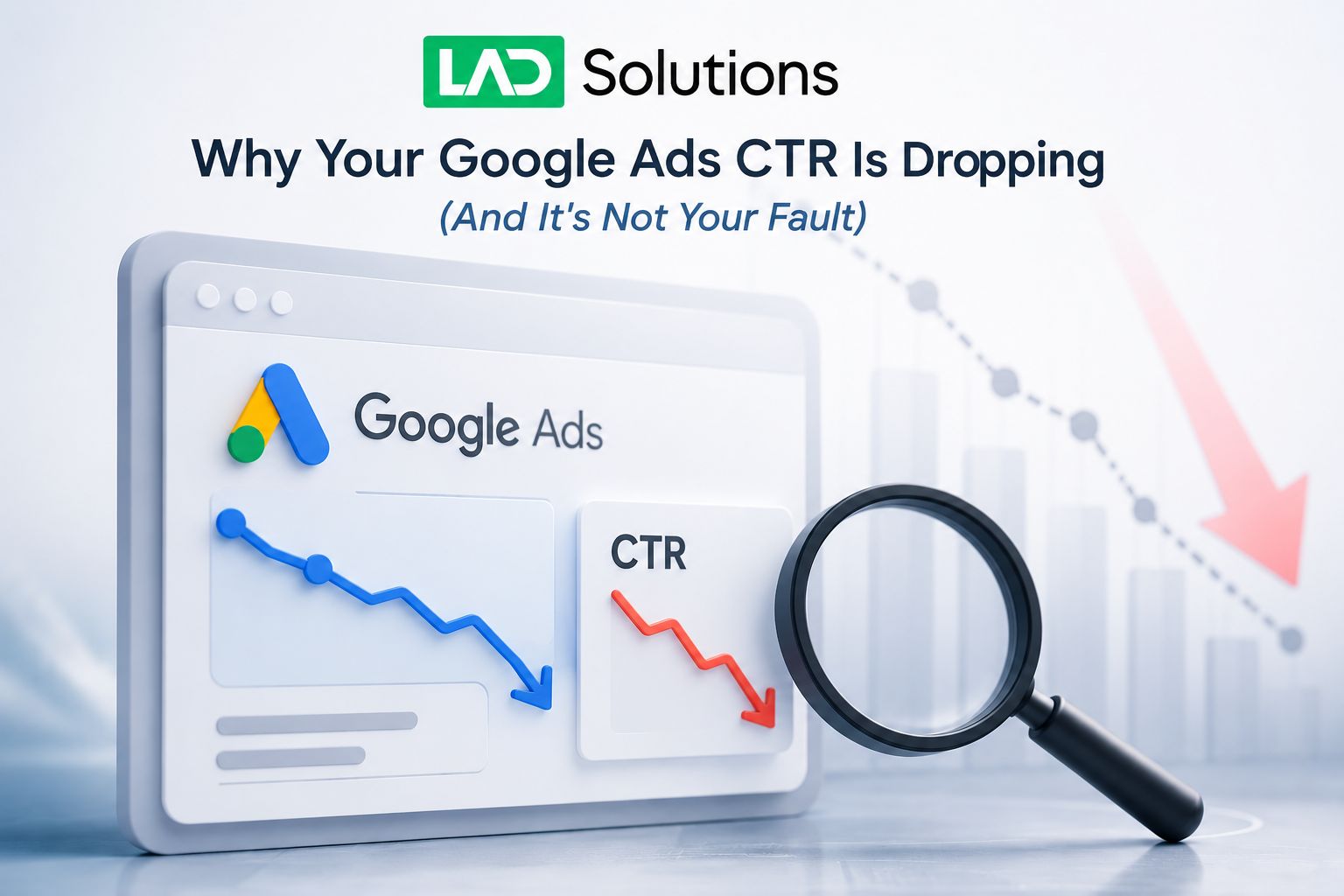
There is a comfortable story about paid search in 2026, and you have almost certainly been told it. Your click-through rate is falling, AI Overviews are eating your clicks, and there is nothing you could have done differently. It is comfortable because it removes the possibility that anything is your fault, and it is popular because it is roughly half true.
The half that is true is genuinely alarming. The half that is missing is the part that would let you do something about it. We are going to walk through both, with the sources attached, because the diagnosis determines the fix and getting this wrong costs real money.
The Structural Shift Is Real, and Bigger Than the Numbers You Have Seen
Start with the headline figure, because most articles are still quoting a stale one. The commonly repeated statistic that 58.5 percent of US Google searches end without a click comes from SparkToro 2024 study, using 2024 data. It is two years old. SparkToro published a new analysis in June 2026 using Similarweb clickstream data, and the number for the first four months of 2026 is 68.01 percent, up from roughly 60 percent in 2024. That is the fastest two-year acceleration since they started tracking it. Fewer than one in three Google searches now sends a click to the open web.
One honest caveat, because it matters and almost nobody includes it. Zero-click does not mean the user vanished. A meaningful share of those sessions end with the user running another Google search rather than leaving, and the measure counts clicks to Google properties such as Maps and YouTube separately from the open web. The trend is unambiguous and the direction is bad for advertisers. The number is also routinely presented as more apocalyptic than the methodology supports. Both things are true.
On the ad side, the most rigorous work available is from Seer Interactive, which tracked roughly 3,100 informational search terms across 42 organizations from June 2024 to September 2025, covering about 1.1 million paid impressions. On queries where an AI Overview appeared, paid click-through rate fell from about 19.7 percent to about 6.3 percent. That is the number driving the industry narrative, and it is a real, well documented compression on informational queries.
The Part Most Articles Have Not Caught Up With
Here is where the comfortable story breaks down. Seer April 2026 update shows paid CTR on AI Overview queries recovering slightly in the first quarter of 2026, while paid CTR on queries without an AI Overview actually declined over the same period. Read that twice. If AI Overviews were the sole engine of your CTR decline, the queries without AI Overviews should be holding steady. They are not.
Something else is also happening, and it is less exotic. Costs are rising; WordStream reported a double-digit year-over-year increase in average cost per click in Q1 2026, the steepest annual jump in several years. Auctions are more competitive. Your own intent mix may have drifted. And if your account has been on autopilot while everyone blamed the algorithm, the ordinary problems have had eighteen months to compound quietly.
So the honest diagnosis is this. Part of your decline is structural and outside your control. Part of it is auction economics. And part of it is the ordinary work that got deprioritized while the industry was busy having an existential crisis. You cannot tell which is which from an aggregate CTR line, which is exactly why the aggregate CTR line is where most advertisers stop looking.
One Number Worth Reorganizing Your Budget Around
If you take a single finding from this article, take this one. Seer found that when a brand was cited inside the AI Overview, it earned substantially more clicks than competitors who were not cited on the same queries, roughly 35 percent more organic clicks and 91 percent more paid clicks, based on Q3 2025 averages.
Sit with the implication. Your presence in AI-generated answers is now a material input into the efficiency of your ad spend on the same query. The ad and the citation are not competing for the click; the citation is making the ad work harder. This is the strongest argument for integrated paid and organic strategy anyone has produced in years, and it is an argument from data rather than from an agency deck. If your paid team and your SEO team report separately, do not talk, and defend separate budgets, you are structurally incapable of acting on this. That is an org chart problem wearing a marketing costume.
What to Actually Do
Diagnose by Query Type Before You Change Anything
Pull your performance broken out by intent rather than in aggregate. AI Overviews are most prevalent on informational queries, where users are learning rather than buying; the Seer research deliberately studied informational terms for that reason. Transactional queries carrying commercial modifiers such as pricing, quote, near me, book now, or comparison language are less exposed, because the AI answer does not complete the task. If your losses are concentrated in informational keyword groups, the structural story fits and shifting weight toward high intent terms is the right move. If your losses are spread evenly, including on transactional terms, AI Overviews are not your primary problem and rebalancing toward transactional will not fix it.
Build AI Visibility as a Paid Search Tactic, Not a Separate Project
Given the citation lift, the work that gets you named inside AI answers is now defensible on paid search economics alone. That means the unglamorous foundation: content on your key commercial topics that carries something a model could not generate on its own, accurate and consistent descriptions of your business across the third-party sources these systems read, and enough technical health that your pages are eligible to be surfaced at all. Note what this is not; Google has publicly stated that special AI files, chunking, AI-specific rewrites, and special schema do nothing for its generative features, so anyone selling you those as a route to AI Overview citation is selling you nothing.
Understand Where Google Is Actually Moving the Inventory
Google I/O 2026, held May 19 and 20, made the trajectory explicit. Liz Reid confirmed AI Mode has passed a billion monthly users, with queries more than doubling every quarter since launch, and AI Mode has become the default search experience. Shopping and Performance Max campaigns may already be serving AI Mode placements, which is worth verifying in your own account rather than assuming; a number of advertisers are buying this inventory without having decided to.
Google also launched Universal Cart, an agentic shopping layer spanning Search, Gemini, YouTube, and Gmail, built on its Universal Commerce Protocol. Be precise about what this is, because it is widely mischaracterized. Universal Cart is not an ad surface you buy into; it is commerce infrastructure that agents read, and what feeds it is your product data, feed accuracy, structured product information, pricing, and inventory signals. For ecommerce, the implication is that feed quality is becoming a visibility lever rather than an operational detail. For service businesses, it mostly is not relevant yet, and you should be skeptical of anyone telling you otherwise.
Prepare for Measurement to Get Worse Before It Gets Better
Google also announced information agents that monitor topics in the background and deliver synthesized updates without the user searching. Keep the scale honest: these launch first for paid Google AI Pro and Ultra subscribers, starting in the US, so the near-term reach is limited. The direction of travel matters more than the launch. Between agentic checkout, in-platform research journeys, and background agents, an increasing share of the path to purchase happens with no session, no UTM, and no trackable click. Your last-click attribution was already flattering the channels that closed rather than the ones that created intent. It is going to get less reliable, not more, which is an argument for watching brand search volume, direct traffic, and blended acquisition cost alongside your platform metrics.
Rebalance Toward Audiences You Actually Own
As upper-funnel search advertising loses efficiency, first-party data and remarketing become proportionally more valuable. People who have visited your site, opened your email, or engaged with your content convert at rates cold search audiences do not approach. This is not new advice. It is simply more true this year than last, and it is the part of your strategy that no algorithm update can take away from you.
The New Performance Framework
Measuring paid search success by CTR and keyword position alone stopped working somewhere around 2024, and 2026 finished the job. The advertisers navigating this well are watching how often they are cited in AI answers, brand search volume as a proxy for whether their market knows they exist, direct traffic trends, and conversion rate by audience segment rather than by keyword. One caution on tooling: Google has stated publicly that no third-party tool has access to its internal ranking or AI systems, so treat any product promising you an internal metric as an estimate with a good sales team. For Google surfaces specifically, the generative AI performance report in Search Console is first-party and free.
Frequently Asked Questions
Why is my Google Ads CTR dropping in 2026?
Usually, a combination rather than a single cause. AI Overviews compress click-through rate on informational queries, and research from Seer Interactive documented paid CTR on those queries falling from roughly 19.7 percent to 6.3 percent between mid-2024 and late 2025. But rising cost per click, auction competition, and drift in your own keyword mix are also in play, and the Seer April 2026 update showed CTR declining on queries without AI Overviews too. Break your performance out by query type before deciding what to fix, because the remedy differs by cause.
What percentage of Google searches end without a click?
About 68 percent of US Google searches ended without a click in the first four months of 2026, according to SparkToro analysis of Similarweb clickstream data, up from roughly 60 percent in 2024. The widely quoted 58.5 percent figure is from the 2024 study and is now out of date. One nuance worth knowing: a portion of those zero-click sessions end with the user running another Google search rather than leaving entirely, so the figure describes clicks to the open web rather than users disappearing.
Do AI Overviews hurt paid ads more than organic results?
On the queries studied, yes. Seer Interactive found paid CTR on AI Overview queries falling roughly 68 percent while organic CTR on the same queries fell roughly 61 percent, between June 2024 and September 2025. That research focused on informational search terms, where AI Overviews appear most often. Transactional queries are less affected, because an AI summary does not complete a purchase. Treat these as directional figures from a third-party study rather than as universal rates for your account.
Does being cited in an AI Overview help my ads?
The available data says yes, substantially. Seer Interactive found brands cited inside an AI Overview earned roughly 35 percent more organic clicks and 91 percent more paid clicks than uncited competitors on the same queries, based on Q3 2025 averages. That makes your AI visibility work a direct input into paid efficiency rather than a separate initiative, and it is the strongest practical argument for running paid and organic as one strategy instead of two budgets.
Should I move the budget away from Google Ads?
Not as a reflex. The right move depends on where your losses are concentrated. If informational keyword groups are carrying the damage, shifting weight toward high-intent transactional terms is well supported. If losses are spread evenly across intent types, the cause is likely auction economics or account drift rather than AI, and cutting budget treats a symptom. Diversifying into first-party audiences and remarketing is sound regardless, because those audiences convert better and no platform change can take them from you.
Where to Start
The instinct after eighteen months of bad news is to accept that this is simply how search works now and manage the decline. That instinct is half right, and the half that is wrong is expensive. Some of your CTR loss is structural and permanent. Some of it is auction math. And some of it is ordinary account work that nobody has done since the panic started, because it is hard to justify optimizing ad copy when the industry keeps telling you the algorithm has already decided.
Finding out which is which takes a proper look at your data broken out by intent, not another article about zero-click search. LAD Solutions runs integrated paid, organic, and AI visibility strategies for businesses across Los Angeles, Orange County, San Diego, and throughout the country. We are a Google Partner, which means we see the account-level reality behind the industry statistics fairly often. Frequently the reality is less dramatic and more fixable than the headlines.
Let us audit your current performance and tell you honestly which part of your decline you can do something about. Contact us here or call us at 844.523.2556 today.